Showing posts with label Cambrian. Show all posts

Friday, March 6, 2009

Traces First #2: On dry ground!

This is one of my favourite. I think this event is special for several instances. First of all, it must have been ONE event. Although quite more important, lifes complexity itself and the rise of metazoans as well as the Cambrian radiation are transitions. These progresses have many mothers and fathers and all are the result of (r)evolutionary teamwork of biotic and abiotic factors. The early terrestrialisation, however, had a chosen one that did it first.

The earliest convincing record of animals on land is described by MacNaughton et al. (2002) from the Cambro-Ordovician Nepean Formation of southeastern Ontario, Canada. They found arthropod trackways on bedding planes of sandstones that represent aolian desert deposits. Evidence for the sub-aerial origin is given by the presence of large scale high-angle trough cross-bedding, and moreover, adhesion marks and wind ripples.

The trackways itself are composed of a series of imprints (fig.1). There are some tracks possessing a continous midline interpreted as dragmark from posterior appendages. Interesting features of these walking traces are little bumps behind individual imprints. This suggests that the arthropod pushed the sediment backwards during walking which is virtually not likely to happen at a sediment surface that is covered with water. I think there is no doubt about the sub-aerial origin of these traces.

Fig. 1: Trackways of early terrestrial Arthropods and their assumed producer. link

The next question is who did it? The authors discussed several possibilities and favoured a group called Euthycarcinoidea which are placed within the crustaceans but are considered to be closely related to the earliest myriapods (fig.2).
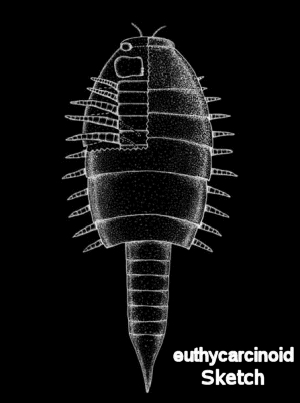
Fig. 2: Euthycarcinoid Arthropods. link


A little bit of discussion is necessary here though. The Euthycarcinoids are probably traceable to the upper Cambrian (Vacarri et al. 2004). Accordingly, the trace fossils described by MacNaughton et al. (2002) may be slightly younger, which implies that the designated trace makers were present before the trackway reported by MacNaughton et al. (2002) was produced. However, there is no terrestrial body fossil described as early as upper Ordovician to Silurian. Furthermore, the alleged producer was not observed in situ with their traces up to now. It cannot be told if they truly did it. Except of smoking gun reports with in situ associations, I tend to be highly incredulous concerning trace-trace maker suggestions. Furthermore, the first terrestrial traces were most likely produced by amphibious arthropods that strolled around in back-beach areas or that were otherwise able to migrate into plains by swimming upstream. They were still predominantly aquatic organisms. However, they were (at least temporarily) able to deal with harsh conditions on land like high temperatures, increased gravity, the problem of respiration and higher impact of UV-radiation and so on.


References

Vacarri, N.E., Edgecombe G.D. and Escudero C., 2004: Cambrian origins and affinities of an enigmatic fossil group of arthropods, Nature 430, 554 – 557.


MacNaughton, R.B., Cole, J.M., Dalrymple, R.W., Braddy, S.J., Briggs, D.E.G., Lukie, T.D., 2002: First steps on land: Arthropod trackways in Cambrian-Ordovician eolian sandstone, southeastern Ontario, Canada. Geology 30/5, 391 – 394.

Wednesday, December 3, 2008

Dudes...

...I should be busy right now: I have to finish my final mapping project in order to complete my studies by the end of december. Furthermore, I will have an interview for a PhD-student position but I won't tell anything until I know how everything worked out. All what I can say right now is that it is a darn interesting project...we will see!


Just to post something (semi)relevant let me introduce you to a new categorie on Nolögic:

Trace fossil of the second


Cruziana problematica Schindewolf, 1928

Coin for scale = 27 mm


I post this one because it is included in the banner of the blog-title. We found these ribbon-shaped bilobate trails on a large float block in Wadi Al Hisa/ Jordan. These traces record superficial grazing or very shallow deposit feeding bahviour performed by small arthropods (?small Trilobites). The surface is a lower bedding plane. You look at a positive hyporelief. The whole surface is covered by hundreds of specimens and even more specimens of their little brothers Rusophycus carbonarius (the little coffee beans). They are Middle Cambrian (Stage 5 or Drumian) in age and are found in a rather marginal marine environment. However, this ichnospecies is reported from marine as well as terrestrial subaquatic deposits and ranges in age from early Cambrian to Cretaceous.

Monday, November 10, 2008

Traces First #1: The Cambrian Explosion (CE)

Intro
Phew! This is truly the flagship among evolutionary progresses and one single post surely cannot embrace a topic that provides enough material to fill up book shelfs. In the course of writing this post it became more and more apparent that it is by far too simplistic just to tell that the presence of trace fossils proves that complex bilateral animals inhabited the sea floor long before they are found in decent body fossil faunas. Although this statement would be the very essence in order to maintain the idea of "traces first", the comparison of these two archives and stating that one predates the other is like comparing the incomparable. I will, anyhow, try to emphasize the role of the ichnology in this event later but first I need to take a deep breath and one step back to provide a minimum of framework.

The first and most obvious message: The "Cambrian Explosion" is a term describing the sudden appearance of numerous "modern" phyla in the fossil record. Nothing more and nothing less. This statement is, in a way, the lowest common denominator of the CE-research, because it just outlines the plain observation. Some people confuse the sudden appearance with absolute evolutionary progress. This might be true but actually this is just one way to interpret it. Although much research has been devoted, it still remains enigmatic in several concerns. But it has been proven that the appearance of complex organisms in the fossil record is one of the last chain links in a cascade of modifications in the earth system. Steps of such an impact are not "sudden" nor do they result from a single causative event. The Cambrian radiation (I like this term better) has a (even on the geological time scale) long and complex prologue. So when did it really start?

Fig. 1: What has Christmas to do with the Cambrian Explosion?

Deck the hall with boughs of holly, Fa la la la la la, la la la la.
When does Christmas start? Some people may say at first Christmas holiday when the children get up early to receive their gifts. Other (german) people may say: No, it's on Christmas eve already. You see, it is a local phenomena. However, this is not the whole story. You have to go and get a tree, bake cookies, buy and prepare all the food, invite your relatives, tell Santa what to get for your kids, set up the decoration, make everything shiny etc. pp. In Germany, we have all this tradition like the "Weihnachtsmarkt" (Christmas market?), Nikolaus and so on. This stuff probably all belongs to Christmas as same as Santa Claus, presents and the tree at Christmas eve itself, doesn't it? Yes, for sure, but the true point of no return is when your children and all other relatives unwrapped their presents and gifts and everyone is happy with his/her new toy, jewellery, fragrance, shirts, socks, ties etc. The living room is a mess, everyone is drinking wine, the turkey is torn into pieces, your cat is going crazy and over the next days, you will have to go and visit all the other people you missed for the whole year probably. Although these are holidays, everyone is very busy. But as I noted above, there is many stuff going on in the "advent" of this event already. It requires much preparation to make all this happen and if one parameter is missing, it cannot really be Christmas then for some people.

My opinion: If we look at the beautiful fossil lagerstätten like Chengjiang and Burgess Shale, we see the holidays - the very essence of the event, when everyone is busy, has new toys to experiment with and so on. In some concerns this analogue might not be very appropriate but I think it is very instructive and fairly outlines the complexity. From all what we know (and I read), one cannot really say: "here it all started". It was a process.

Fig. 2: Treptichnus cf. pedum from the lower Middle Cambrian of Jordan. This is not a very typical specimen. We found it during the field session in Jordan. Photo courtesy of G. Mángano.

Trace fossils and their role in the "Cambrian Explosion"
So now back to the actual business. What is the role of ichnology here? As I noted above, the most simple message is that some trace fossils are so complex that their creation requires sophisticated nervous systems and locomotory mechanisms as well as some sort of motivation (= behaviour). Accordingly, trace fossils demonstrate that there were animals, which did match all this characteristics, already before some of them passed into the body fossil record. Therefore, the first really complex trace fossil Treptichnus pedum (fig. 2; for taxonomists: some people prefer Trichophycus pedum, originally described as Phycodes pedum, Seilacher 1955) was chosen to define the base of the Cambrian. T. pedum is an array of alternating banana-shaped burrows that have been created within the sediment. To describe it properly, all three spatial dimensions are needed. Thus, it is a true burrow created by a bilateral-symmetrical animal. In other words, the trace maker had a left and a right side, it had a sense for "up" and "down" and it probably possessed an aperture for all incomings and one for the rest. Older trace fossil assemblages from the Ediacaran are characterised by the presence of horizontal traces only. Typical strategies employed by Ediacaran biota are surface scratchings, horizontal (under-)mat mining, rather unspecialised superficial grazings and something like that. Around the Precambrian-Cambrian-transition, the discovery of the third dimension by benthic organisms had tremendous impact on the environment and the whole face of the earth.

Fig. 3. Cartoon illustrating the 'Agronomic Revolution'.
From Fedonkin et al. 2007. Drawing by Peter Trusler.
I think there is an error at the lower right. It should be "phanerozoic mixgrounds".

What has been very instructively termed by Seilacher (1997) as the "Agronomic Revolution" or "Trophic Escalation", illustrates the fundamental changes across the the pC-C-transition (see fig. 3). First of all, there is a new strategy as demonstrated by deep vertical burrows (Skolithos, Monocriterion, Arenicolites, Teichichnus to name a few): Infaunalisation. Animals appreciated to colonise the sediment column, which is in fact really advantageous because it provides protection from abiotic and biotic stress factors. Furthermore they were able to explore new food sources. (1) Infaunal detritus feeding: Think of the wasted resources in the Ediacaran. Plenty of organic matter that just has been buried beneath sticky algal mats. (2) Suspension feeding: No matter how strong bottom currents are, just evert your feeding apparatus and current will do the rest without disturbing you in your nice burrow. (3) Passive predation: Wait in your hole for a prey that strolls along your burrow. All in all a very progressive strategy. This biotic invention didn't change only the ecological conditions significantly. It affected whole chemical fluxes in the entire ocean. All the soluble components like phosphate, calcium, silica, magnesium re-entered the marine chemical cycle by deep and thorough bioturbation at the expense of mat-sealed sediment-water interfaces. The composition of sea water presumably changed completely. This, in turn, most likely made the subsequent biomineralisation event possible altogether. This fundamental modification was in a way the advent of the big party that is recorded by the terminal Lower Cambrian fossil lagerstätten.

Further complication? Here we go: Jensen (2003) subsumed that rise of trace fossil complexity is not just documented from the lowermost Cambrian. He stated, and convincingly demonstrated that the "Neoproterozoic trace fossils represent the initiation of a rapid but gradual build-up of infaunal activity, which increased markedly in the Cambrian". Furthermore he concludes that the presence of some distinct trace fossil (e.g. Spiroraphe) together with Ediacaran forms suggests that the evolution of bilateral animals is already under way. So when did the so called "Cambrian Explosion" start? You know what? I really do n't know.

Some key resources for this topic are: Seilacher (1956), Seilacher (1974), Crimes (1992), Droser et al. (2002) as already noted Jensen (2003), Seilacher et al. (2005). This story is by far not completely told yet and, in fact, the evaluation of trace fossils in connection with the CE is still a hot frontier in geo/biosciences.


References:

Crimes, T.P., 1992: Changes in the trace fossil biota across the Proterozoic-Phanerozoic boundary. J. geol. Soc. London., vol. 149, pp. 637–646

Droser, M.L., Jensen, S., Gehling, J.G., 2002: Trace fossils and substrates of the terminal Proterozoic–Cambrian transition: Implications for the record of early bilaterians and sediment mixing. PNAS, vol 99. no 20, pp. 12572-12576.

Fedonkin, M.A., Gehling, J.G., Grey, K., Narbonne, G.M., Vickers-Rich, P., 2007: The rise of animals. Evolution and Diversivication of the Kindgom Animalia. Johns Hopkins University Press, Baltimore.

Jensen, S., 2003: The Proterozoic and Earliest Cambrian Trace Fossil Record; Patterns, Problems and Perspectives. Integr. Comp. Biol., vol. 43, pp. 219–228.

Seilacher, A., 1955. 4. Spuren und Fazies im Unterkambrium. In: Schindewolf, O.H., Seilacher, A. (Eds.), Beitrage zur Kenntnis des Kambriums in der Salt Range (Pakistan), Akademie der Wissenschaften und der Literatur zu Mainz, Mathematisch-naturwissenschaftliche Klasse, Abhandlungen, vol. 10, pp. 373 – 399.

Seilacher, A., 1956. Der Beginn des Kambriums als biologische Wende. Neues Jahrbuch fur Geologie und Palaontologie, Abhandlungen 103, pp. 155–180.

Seilacher, A., 1997: Fossil Art. Royal Tyrell Museum of Palaeontology, Drumheller, Alberta, 64 p.

Seilacher, A., Buatois, L.A., Mángano, M.G., 2005: Trace fossils in the Ediacaran–Cambrian transition: Behavioral diversification, ecological turnover and environmental shift. Palaeogeography, Palaeoclimatology, Palaeoecology, vol. 227, pp. 323–356.


Friday, October 3, 2008

Dead Sea / Jordan

This one is about the fieldwork in Jordan that I conducted for my Master research project in winter 2006 at the area of the southern Dead Sea / Jordan . I can't go too much into detail right now because there is nothing published about this stuff yet and me and my supervisors are still debating about some implications concerning the depostional environment. Anyway, I don't want to miss this opportunity sharing some shots from this interesting country.


Introduction

The general objective of this study was to document a certain succession of sedimentary rocks with respect to the depositional environment and (trace) fossil content. Most of the previous work on this Member did not provide a detailed picture concerning these parameters. So it was my task to figure out which palaeo-environments (e.g. estuary, delta or tidal flat) are recorded by these sandstones and shales. The sexy thing about the Hanneh Member is that it is highly fossiliferous (extraordinarily preserved trace fossils!). Fossils, and in particular trace fossils (they are "in situ" structures), are well suited for environment characterisation since they evidence biological, physical (and chemical) parameters during and after deposition. Furthermore, they are perfect to assess the ecological relationships. The Hanneh Member and the underlying Numayri Member, respectively, is biostratigraphically well fixed with Trilobite body fossils and dated as lowermost Middle Cambrian (or Cambrian Stage 5 in the updated stratigraphic nomenclature). In fact, this is approximately the age of the well known Burgess Shale and Chengjiang Fossil Lagerstätte (this is slightly older though). So, the Hanneh Member documents ecological conditions right on the edge of the Cambrian Radation as well as the Substrate or "Agronomic Revolution".

This is the whole Burj Formation exposed in the upper course of Wadi Umm Jafna. The distinct cliff represents the middle calcareous Numayri Member which is reconstructed as a open marine carbonate-ramp system succeeding into an intertidal to supratidal sabkha-like environment. The purple shales below are interpreted as restricted to marginal marine system that documents the initial marine transgression upon a fluvial braid plain. The green slope at the upper part is the Hanneh Member which is suggested to has been laid down in lagoonal, tide-dominated environments. The documentation of these strata is very general (e.g. BENDER 1974, AMIREH et al. 1994, SCHNEIDER et al. 2007), and only two ichnotaxa were described by SEILACHER (1990) from this member. The uppermost strata (Umm Ishrin Formation) represent fluvial sediments. So in general we have a terrestrial-marine-terrestrial succession exposed. In terms of sequence stratigraphy: a typical Transgression-Highstand-Regression profile.


The smooth, greenish slope represents the whole Hanneh Member. Probably the best exposure in Wadi Uhaymir/ Tayan if you want to study it bed by bed. In general, you can see and overall fining upward trend with sandy portions in the lower and shales in the upper part.


Field observations

Just some shots of the sediments, trace fossils, and some suggestions about the facies and structures.


Me and Dr. Gabriela Mángano studying tidal flat sediments (Zerqa Ma'In Outcrop, Northern Dead Sea).


Typical tidal-channel sediments. Trough cross-bedded sandstones with distinct alternating flow direction. Good evidence for waning flow conditions (typical for tides) are tidal bundles or double mud drapes (dark laminae within the cross bed, Zerqa Ma'In Outcrop, Northern Dead Sea)


The lower Hanneh at Wadi Issal. You see cross beddings representing bar-accretion in subtidal sandbars. In general, a high energy environment below the subtidal/ intertidal boundary where sea bottom is subjected to permanent wave action and currents. "Tree" for scale (1,3 m).


The middle Hanneh at Wadi Qunai. Essentially, both pictures display the same facies, intertidal heterolithics. Rhythmic alternations of shales and sandstones. Plane beds, climbing ripple sequences (the bright level above the hammer) as well as mud drapes indicate strong alternations in current strenghts. However, evidence for emergence (desiccation cracks, flat-topped ripples) lack and an alternative interpretation of these strata would be a slightly subtidal prodelta. As I said above, we are still debating.


A nice specimen of Rosselia, a dwelling burrow of worms (most likely Polychaetes) maintained for deposit feeding and ?suspension feeding. These ones were very crucial in the interpretation in discriminating intertidal from subtidal environments. Such deep, robust burrows are not likely to occur in Cambrian tidal flats. In the lower Palaeozoic, you need stable, marine conditions to host a fauna like this. So the surrounding sediment most likely represents a subtidal prodelta. Wadi Uhaymir.


This seems to be the upper delta front to delta top. I think the story is, that absent vegetation (it's Cambrian !) and arid climatic conditions (during time of deposition) led to an impermanent, dynamic fluvial run-off. Accordingly, the resulting delta body is not very distinct. Wadi Umm Jafna.


The Delta plain (Umm Ishrin Formation). Some sort of sheet flood deposits. Probably the most attractive sandstone I'd ever seen. Wadi Uhaymir.


Superbly preserved arthropod scratches (most likely Trilobites). Some people say they are an ichnospecies of Dimorphichnus. I am still not very happy with the interpretation. Such structures are suggested to represent superficial grazing performed by trilobites. I think they are just current-drifted arthropods trying to get their feet on the ground. Accordingly, most likely Monomorphichnus isp. Wadi Uhaymir.


Wonderfull specimens of Archaeonassa fossulata. Superficial grazings of worms, small arthropods or early gastropods. Wadi Qunai.


500-something million years old arthopod traces.


Massive! Contorted beds referred to as "ball and pillow" structures. Either these are load- structures due to high sedimentation rates on water-saturated stacks of sediment or seismites (seismic shock-induced bedding failure). Wadi Tayan.


A last geology goodie. This is textbook-like unconformity. Lower Cambrian sedimentary rocks superposing Precambrian Volcanites. Wadi Qunai.


Miscellaneous

Gorgeous Wadi landscape in Wadi Al Hisa.


Mahmud (l.) and Abdullah (r.). Awesome bedouin-dudes. We shared food and field equipment. I ran out of pencils and writing paper. Was worth it. I got traditional "desert wraps" and tea. Unfortunately, i could'nt talk to them at all.


Didn't work.

We didn't investigate this stuff. I suppose these are Cretaceous Limestones and Marls. Very widespread on the Arabian Peninsula. The dark range in the background most likely is Ordovician.


On the way to Petra.


Reference(s):

Amireh, B. S., Schneider, W., Abed, M. A., 1994: Evolving fluvial-transitional-marine deposition through the Cambrian sequence of Jordan. Sedimentary Geology, 89, pp. 65 – 90.

Bender, F., 1974: Geology of Jordan. Borntraeger, Berlin.

Schneider W., Amireh B. S., Abed A.M., 2007: Sequence analysis of the Early Paleozoic sedimentary systems of Jordan. Zeitschrift der Deutschen Gesellschaft für Geowissenschaften, 158 (2), pp. 225 – 247.

Seilacher, A., 1990: Chapter 32: Paleozoic trace fossils. in SAID, R., (ed.), The Geology of Egypt. A.A. Balkema, Rotterdam, pp. 649 – 722.