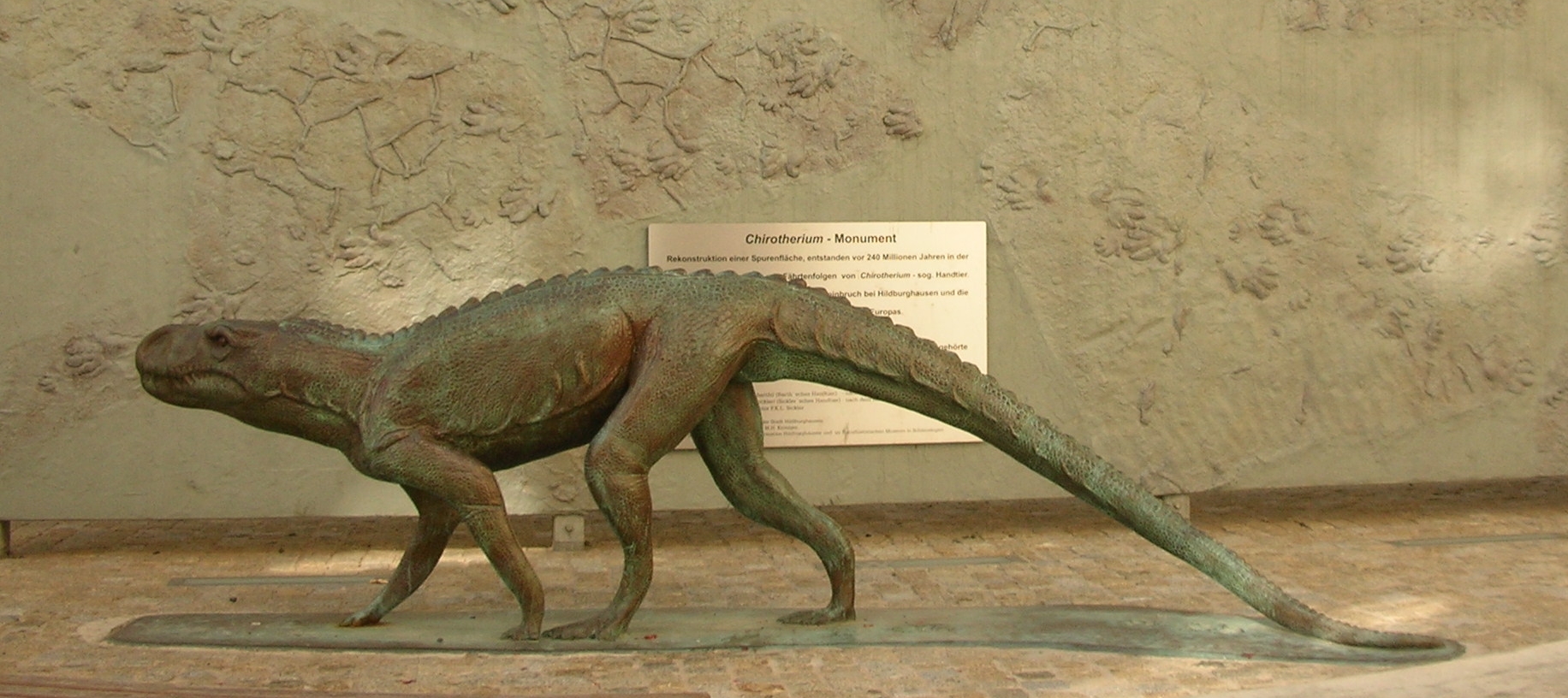
A team of scientists from the TU Freiberg recently unearthed well-preserved tetrapod footprints from the Triassic of the High Atlas (Morocco). Surprisingly, this ichnofauna is dominated by the ichnogenus Chirotherium, wich is suggested to present an exclusive element of North-Pangean or Laurasian localities that are nowadays associated to Europe, China and North America. Although the scientists are aware that similar trackways were reported from western Gondwana (Argentina; Peabody, 1955), it was stated by several local newspapers that the imprints represent the first occurrences of such traces from Gondwana.
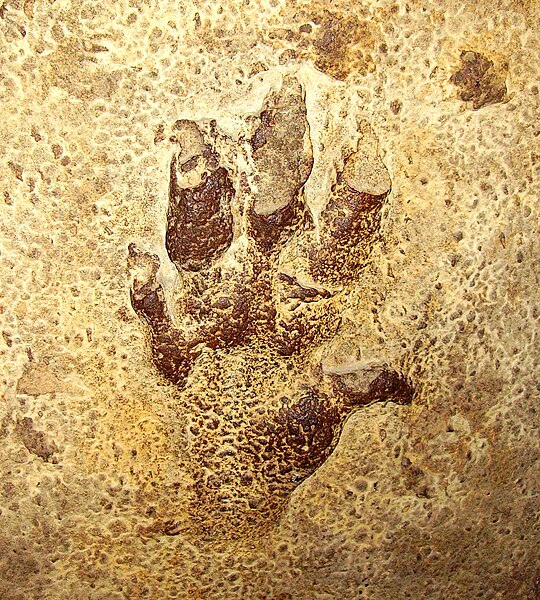
 Fig. 1: Pes (the big one) and manus imprint of the ichnogenus
 Chirotherium from the Triassic of Morocco (courtesy of Jan Fischer).
Extensive field work yielded several well-preserved imprints and trackways that can be assigned to the ichnospecies Chirotherium barthii (fig. 1), which is described from (watch out, confusing terms) upper Lower Triassic (Olenekian) to lower Middle Triassic (Anisian) rocks like the Moenkopi Formation of the western U.S. or the Buntsandstein of Central Europe (Klein & Haubold, 2007; and references therein).
As noted above, at least the ichnogenus seems to occur in Argentina as well but the new data from Morocco now strongly support the hypothesis of Peabody (1955) that Chirotherium is a track with a global distribution and its archosaurian producer inhabited the northern and southern hemisphere (see a reconstruction of the palaeoenvironment in fig. 2).
All specimens are currently under investigation by Hendrik Klein, Sebastian Voigt and Jörg Schneider of the TU Freiberg and I expect some interesting papers to be published in near future. For instance, the age of these findings will play an important role in unravelling the evolutionary history of archosaurs.
 Fig. 2: A reconstruction of the palaeoenvironment based on the
geological context and sedimentary analysis of the track bearing interval.
Drawn by F. Spindler (taken from Sächsische Zeitung, march 20/21, 2010).
References
Peabody, F.E., 1955: Occurrence of Chirotherium in South America: Geological Society of America Bulletin, v. 66, p. 239-240.Klein, H., Haubold, H., 2007: Archosaur footprints - potential for biochronolgy of Triassic contintal sequences. In Lucas, S.G., Spielmann, J.A., (eds): The Global Triassic. New Mexico Museum of Natural History and Science Bulletin 41.