Recently, I returned from a field trip with American (Jim Jenks and Kevin Bylund) and French (Dr. Arnaud Brayard) Cephalopod researchers. I have been in the south-western U.S. for almost 4 weeks to see the Panthalassian faunas mainly of the Smithian and Spathian (Upper Early Triassic, Olenekian if you want). I've got a lot of things to do right now so I just will post some pictures from the field trip and some ichnologic goodies. Almost everything that is suggested for publication will emerge here (if any) after definite publication. It is not that I am conceited or afraid that someone snitches my ideas but most journals require that the submitted material is not published elsewhere in any form (hence, including blog-posts). In fact, currently I am working on a manuscript on some trace fossils from the Dolomites that I'd love to show you. Anyway back to the U.S. (as always: click to enlarge!):
 The ?Thaynes Formation at the Dog Valley locality (Pahvant Range, central Utah).
 Our camp with the Thule Valley in the background seen from the Disappointment Hills (Confusion Range, Utah) . The backmost mountains belong to the House Range and are mainly composed of Cambrian sediments.
 One of the sections at the Disappointment Hills locality. The succession of interest starts at the right with a calcarenitic bed (the bright bedding plane) blanketing a ?permian paleo-relief. The Triassic here is represented by the Thaynes Formation (Smithian and Spathian) .
 Well, the desert can be a lonely place...
 ...but furry guests show up from time to time.
 Thats a locality called Smiths Phalen Ranch near Currie (Nevada). See the post on Ammonoidea.
 "Superb" outrcop conditions in NE-Nevada (Winecup Ranch, or something). We weren't even sure if its Lower Triassic at all.
 The morning after a 25°C drop in temperature.
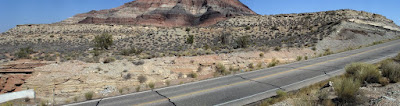 The Spathian Virgin Member (stratigraphic nomenclature is debated, some researcher refer to the Vrgin Limestone Formation) near Hurricane. Basically, a shale interbedded with a series of prominent limestone ledges.
 The lowermost of such "ledges", here very variable in thickness. It pinches out towards the left. I think it represents an estaury filling incisions in the underlying terrestrial red beds. The base of the Virgin member is highly variable in facies. It must have been a very dissected coastline with shoals, tidal flats, lagoons and estuaries. Honey Moon Trail east of the Hurricane cliffs.
 The same little mesa showing the prominent pinch-out towards the left.
 The Hurricane Cliffs east of Hurricane (Utah).
 So called "wrinkle structures". Little pseudo ripples which are formed by microbial mats. It is considered as an "anachronistic" facies showing up in areas or times when grazing and bioturbation in general is dramatically reduced due to nonexistence of grazers and burrowers (Lower Cambrian) or as a result of a previous massive extinction (Lower Triassic). If you are interested read Pruss et al. 2004 for instance.
 An ichnologic goodie: Cruziana in the lower Triassic. Usually, Cruziana is suggested to have been produced by Trilobites. As they went extinct in the course of the end-Permian mass extinction, similar structures can be obviously produced by someone else. A paper dealing with this topic is Zonneveld et al. 2002. The occurence reported in that reference is dated to the Middle Triassic. So my specimen (Spathian Virgin Member) should be the earliest large Cruziana after the end-Permian Mass extinction found so far. Well, the photographed specimen is not the whole story and I hope I can come back to this one when we have better data and a publication.
 Me and my little clam truck.
References
Pruss S. B., Fraiser M. L., Bottjer D. J. 2004: The proliferation of Early Triassic wrinkle structures: implications for environmental stress following the end-Permian mass extinction. Geology, 32, 461–464.
Zonneveld J. P., Pemberton S. G., Saunders T. D. A., Pickerill R. K., 2002: Large, Robust Cruziana from the Middle Triassic of Northeastern British Columbia: Ethologic, Biostratigraphic, and Paleobiologic Significance. Palaios, 17, 435-448.

 Probably on every student field trip a picture like this is going to be taken. It was a third years field trip, so you still see tools from DIY markets, which are infact unsuitable for torturing rocks. They easily chip. I once shot a fellow student in the leg while I tried to decompose a cherty limestone. Blood everywhere, I tell you. She sued me and I still have to pay her smart money. So get decent gear for fieldwork. Safety first!
 Probably on every student field trip a picture like this is going to be taken. It was a third years field trip, so you still see tools from DIY markets, which are infact unsuitable for torturing rocks. They easily chip. I once shot a fellow student in the leg while I tried to decompose a cherty limestone. Blood everywhere, I tell you. She sued me and I still have to pay her smart money. So get decent gear for fieldwork. Safety first!