Showing posts with label ichnology. Show all posts

Monday, March 29, 2010

Chirotherium World Tour

A team of scientists from the TU Freiberg recently unearthed well-preserved tetrapod footprints from the Triassic of the High Atlas (Morocco). Surprisingly, this ichnofauna is dominated by the ichnogenus Chirotherium, wich is suggested to present an exclusive element of North-Pangean or Laurasian localities that are nowadays associated to Europe, China and North America. Although the scientists are aware that similar trackways were reported from western Gondwana (Argentina; Peabody, 1955), it was stated by several local newspapers that the imprints represent the first occurrences of such traces from Gondwana.

Fig. 1: Pes (the big one) and manus imprint of the ichnogenus
Chirotherium
from the Triassic of Morocco (courtesy of Jan Fischer).


Extensive field work yielded several well-preserved imprints and trackways that can be assigned to the ichnospecies Chirotherium barthii (fig. 1), which is described from (watch out, confusing terms) upper Lower Triassic (Olenekian) to lower Middle Triassic (Anisian) rocks like the Moenkopi Formation of the western U.S. or the Buntsandstein of Central Europe (Klein & Haubold, 2007; and references therein).

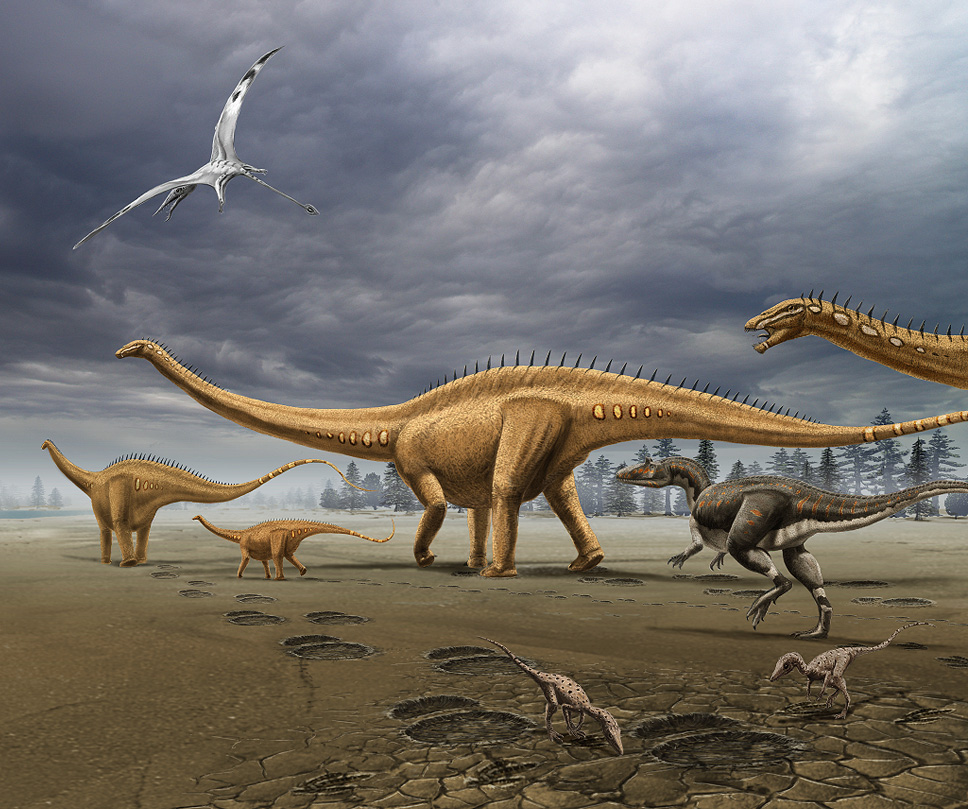
As noted above, at least the ichnogenus seems to occur in Argentina as well but the new data from Morocco now strongly support the hypothesis of Peabody (1955) that Chirotherium is a track with a global distribution and its archosaurian producer inhabited the northern and southern hemisphere (see a reconstruction of the palaeoenvironment in fig. 2).

All specimens are currently under investigation by Hendrik Klein, Sebastian Voigt and Jörg Schneider of the TU Freiberg and I expect some interesting papers to be published in near future. For instance, the age of these findings will play an important role in unravelling the evolutionary history of archosaurs.

Fig. 2: A reconstruction of the palaeoenvironment based on the
geological context and sedimentary analysis of the track bearing interval.
Drawn by F. Spindler (taken from Sächsische Zeitung, march 20/21, 2010).


References

Peabody, F.E., 1955: Occurrence of Chirotherium in South America: Geological Society of America Bulletin, v. 66, p. 239-240.

Klein, H., Haubold, H., 2007: Archosaur footprints - potential for biochronolgy of Triassic contintal sequences. In Lucas, S.G., Spielmann, J.A., (eds): The Global Triassic. New Mexico Museum of Natural History and Science Bulletin 41.

Friday, January 8, 2010

Traces First #3: The tetrapod terrestrialisation

This post actually just represents one of those reviews that swamp the internet right now. However, it just fits so perfectly my Traces First-label that I simply can't refuse to put this one on nologic.

Recently, Niedźwiedzki and co-workers (2010) discovered vertebrate trackways in the early Middle Devonian of Poland. These traces, which represent imprints of walking tetrapods, demonstrate that backboned animals walked the earth approximately 20 Million Years earlier than has been previoulsy inferred from body fossils like Tiktaalik and Panderichthys for instance. Tiktaalik from the late Devonian of the Canadian arctic is suggested to represent a sarcopterygian fish, which is closely related to early land-based tetrapods like no other (primary) aquatic animal of the fossil record (Daeschler et al. 2006)

The recent finding from Poland is remarkable for two reasons:

(1) The morphology of the imprints suggests that they were produced by real limbs. If a creature would use stump-like fins as seen in Tiktaalik for extra-aquatic locomotion, the trace fossil would appear more like drag way, not a track way (haha). The traces from Poland show discrete imprints with no drag marks or something. The implication of this feature is that free moving limbs must have evolved much earlier.

(2) The traces were found in a completely unexpected environment. The terrestrialisation of vertrebrates has always been suggested to have happend somewhere in swamp-like landscapes or along river channels. The sedimentary rocks of the trace fossil bearing level are interpreted as strata deposited on a tidal flat. This offers two possibilties: Either first vertrebrates emerged from the marine (which to my knowledge has not been considered so far) or they came from somewhere else. Togehter with point (1), the latter opportunity pushes the terrestrialisation even further back in time.

With the contribution of Niedźwiedzki et al. (2010), another macro-evolutionary step is well predated by means of traces fossils.

As neat video from nature is available on youtube:


References:

Niedźwiedzki, G., Szrek, P., Narkiewicz, K., Narkiewicz, M., Ahlberg, P.E., 2010: Tetrapod trackways from the early Middle Devonian period of Poland , nature, v. 463, p. 43-48 , doi:10.1038/nature08623.

Daeschler, E.B., Shubin, N.H., Jenkins, F.A.Jr, 2006: A Devonian tetrapod-like fish and the evolution of the tetrapod body plan, Nature, v. 440, p. 757-763, doi: 10.1038/nature04639.

Tuesday, December 15, 2009

Run crinoid, run!

This one has been posted already here and there on the net and actually, the paper was published 2.5 years ago. However, this report really surprised me and I want to share my amazement.

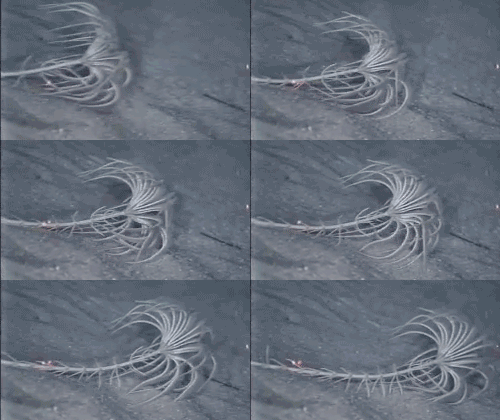
Fig. 1: Gif-movie showing crawling crinoid in quick motion.
Picture from cover of Palaeontologia Electronica Vol 10/1


Baumiller and Messing (2007) report that extant isocrinids are able to move as fast as 10 - 30 mm per second using their "arms" to crawl over the seafloor (fig. 1). Although some groups of crinoids were suggested and proven to perfom some sort of locomotion, the authors provide evidence for an almost "benthic-vagile" lifestyle of a group of organisms that is largely recognized as de facto sessile.

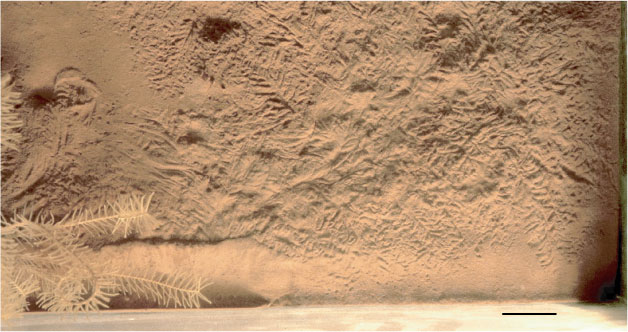
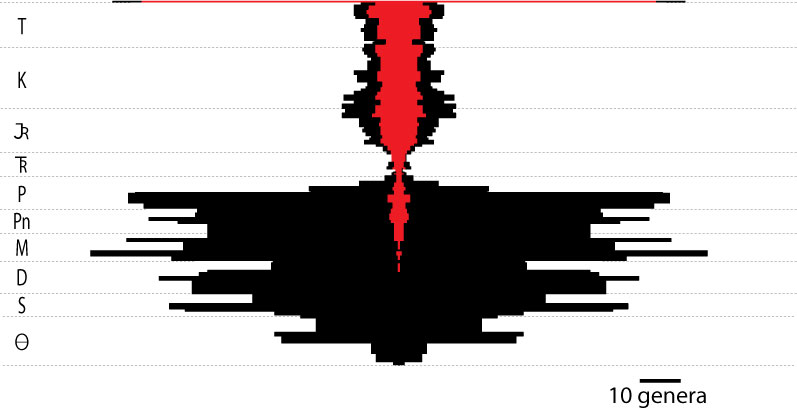
This contribution concerns me for two reasons. First, I am highly interested if there are some trace fossils that were found to represent crinoid locomotion (see fig. 2) and second, the portion of crinoids suggested to apply this kind of locomotion is highest in the Triassic (fig. 3).

Fig. 2: Traces of Davidaster rubiginosa in a fishtank experiment, scale bar: 20 mm (Baumiller and Messing, 2007).


Fig. 3: Generic diversity of crinoids from Ordovician to modern times. Red bars represent the portion of crinoidtaxa that might have been able to perform the observed mode of locomotion (Baumiller and Messing, 2007).


Working in the lower Triassic with a keen interest in ichnology, I will keep this work in my head when returning to the field. Does anybody knows about crinoid trace fossils?


Reference

Baumiller, T.K., and Messing, C.G., 2007: Stalked Crinoid locomotion, and its ecological and evolutionary implications. Palaeontologia Electronica, v. 10/1. http://palaeo-electronica.org/paleo/2007_1/crinoid/index.html

Thursday, November 19, 2009

From the east coast to the west coast...

Recently, I returned from a field trip with American (Jim Jenks and Kevin Bylund) and French (Dr. Arnaud Brayard) Cephalopod researchers. I have been in the south-western U.S. for almost 4 weeks to see the Panthalassian faunas mainly of the Smithian and Spathian (Upper Early Triassic, Olenekian if you want). I've got a lot of things to do right now so I just will post some pictures from the field trip and some ichnologic goodies. Almost everything that is suggested for publication will emerge here (if any) after definite publication. It is not that I am conceited or afraid that someone snitches my ideas but most journals require that the submitted material is not published elsewhere in any form (hence, including blog-posts). In fact, currently I am working on a manuscript on some trace fossils from the Dolomites that I'd love to show you. Anyway back to the U.S. (as always: click to enlarge!):

The ?Thaynes Formation at the Dog Valley locality (Pahvant Range, central Utah).


Our camp with the Thule Valley in the background seen from the Disappointment Hills (Confusion Range, Utah) . The backmost mountains belong to the House Range and are mainly composed of Cambrian sediments.


One of the sections at the Disappointment Hills locality. The succession of interest starts at the right with a calcarenitic bed (the bright bedding plane) blanketing a ?permian paleo-relief. The Triassic here is represented by the Thaynes Formation (Smithian and Spathian) .


Well, the desert can be a lonely place...


...but furry guests show up from time to time.


Thats a locality called Smiths Phalen Ranch near Currie (Nevada). See the post on Ammonoidea.


"Superb" outrcop conditions in NE-Nevada (Winecup Ranch, or something). We weren't even sure if its Lower Triassic at all.


The morning after a 25°C drop in temperature.


The Spathian Virgin Member (stratigraphic nomenclature is debated, some researcher refer to the Vrgin Limestone Formation) near Hurricane. Basically, a shale interbedded with a series of prominent limestone ledges.


The lowermost of such "ledges", here very variable in thickness. It pinches out towards the left. I think it represents an estaury filling incisions in the underlying terrestrial red beds. The base of the Virgin member is highly variable in facies. It must have been a very dissected coastline with shoals, tidal flats, lagoons and estuaries. Honey Moon Trail east of the Hurricane cliffs.


The same little mesa showing the prominent pinch-out towards the left.


The Hurricane Cliffs east of Hurricane (Utah).


So called "wrinkle structures". Little pseudo ripples which are formed by microbial mats. It is considered as an "anachronistic" facies showing up in areas or times when grazing and bioturbation in general is dramatically reduced due to nonexistence of grazers and burrowers (Lower Cambrian) or as a result of a previous massive extinction (Lower Triassic). If you are interested read Pruss et al. 2004 for instance.


An ichnologic goodie: Cruziana in the lower Triassic. Usually, Cruziana is suggested to have been produced by Trilobites. As they went extinct in the course of the end-Permian mass extinction, similar structures can be obviously produced by someone else. A paper dealing with this topic is Zonneveld et al. 2002. The occurence reported in that reference is dated to the Middle Triassic. So my specimen (Spathian Virgin Member) should be the earliest large Cruziana after the end-Permian Mass extinction found so far. Well, the photographed specimen is not the whole story and I hope I can come back to this one when we have better data and a publication.


Me and my little clam truck.


References

Pruss S. B., Fraiser M. L., Bottjer D. J. 2004: The proliferation of Early Triassic wrinkle structures: implications for environmental stress following the end-Permian mass extinction. Geology, 32, 461–464.

Zonneveld J. P., Pemberton S. G., Saunders T. D. A., Pickerill R. K., 2002: Large, Robust Cruziana from the Middle Triassic of Northeastern British Columbia: Ethologic, Biostratigraphic, and Paleobiologic Significance. Palaios, 17, 435-448.

Tuesday, July 28, 2009

Trace fossil of the second III: Asteriacites lumbricalis

The Tfots today is Asteriacites lumbricalis von Schlotheim, 1820, a resting trace produced by the (in)activity of ophiuroid echinoderms or brittle stars (Twitchett & Wignall 1996). I took these photographs from material found on the slopes of Costabella mountain in the Dolomites. These slabs are float from an outcrop exposing the Campil Member of the middle Werfen Formation (Lower Triassic, Early Olenekian). These trace are quite widespread in this member and known for more than a hundred years although they were erroneously recognised as body fossils in the first place (e.g. Wittenburg 1908). They come from more or less storm-dominated shoreface deposits composed of micaceous fine-grained sandstones and siltstones.

Thanks to a comment by David, I hoped to see some decent specimens during the recent field session and finally I was really lucky finding these well-preserved traces at the last day of the campaign. I never saw better ones at least in the literature so far.


Fig. 1: Asteriacites lumbricalis preserved as convex hyporelief (positive structure on a lower bedding plane). Black bar represents 5 mm.


Fig. 2: Asteriacites lumbricalis preserved as concave epirelief (negative structure on an upper bedding plane). Black bar represents 5 mm. Note the ripple-marks.


References:

Schlothheim, E.F. von, 1820: Petrefactenkunde auf ihrem jetzigen Standpunktedes Thier- und Pflanzenreichs der Vorwelt. Gotha, Becker, 437 p. durch die Beschreibung seiner Sammlung versteinerter und fossiler überreste.

Twitchett, R.J., Wignall, P.B., 1996: Trace fossils and the aftermath of the Permo-Triassic mass extinction: evidence from northern Italy. Palaeogeography, Palaeoclimatology, Palaeoecology 124, 137–152.

Wittenburg, P. von, 1908: Beiträge zur Kenntnis der Werfener Schichten Südtirols. Geologische und Palaeontologische Abhandlungen 8, 251–289.


Friday, May 1, 2009

Trace fossil of the second II: Brutalichnus brutalis Mikuláš et. al 2006

Today I picked this one because of its adorable name. Brutalichnus has been erected by Mikuláš et. al 2006 with a bunch of other neat traces like Nihilichnus and Machichnus from bone material found in Miocene Sediments near Chomutov (Czech Republic). All of these structures represent biting and gnawing traces on bones. Brutalichnus brutalis is interpreted by the authors as breakage due to bites of animals in order to feed on cancellous bones which are rich in organic material. Evidence for this hypothesis is provided by small radial patterns at the points where the bone is broken. It proves that the bones did not simply collapse as a result of compaction.
Fig. 1: Brutalichnus brutalis on a mandible (Mikuláš et al. 2007).


Fig. 2: The suggested trace maker action being responsible for the observed morphology (Mikuláš et al. 2007)


Reference
Mikuláš R., Kadlecová E., Fejfar O., Dvořák Z. (2007): Three New Ichnogenera of Biting and Gnawing Traces on Reptilian and Mammalian Bones: A Case Study from the Miocene of the Czech Republic. Ichnos, 13, p. 113–127. link

To close this post you may enjoy the audio version of Brutalichnus brutalis: Converge's Fault and Fracture.

Friday, April 24, 2009

Global Ichnology

Accidentally found on youtube: "Trace fossils" in different languages spoken by leading scientists of this discipline.

Monday, April 13, 2009

Trampled under Hoof

Last Weekend, I was recruited as driver for a student field trip. Location & Time: Jura(-ssic) / Western Switzerland. In fact a great place for ichnologists: the first visited outcrop is one of the best track sites currently exposed worldwide. It is located just a few km in the north of Courtedoux. There are hundreds of imprints of walking sauropods, some theropod tracks as well as thousands of invertebrate traces. This trampled ground is found within the Reuchenette Formation which roughly represents the Kimmeridgian (middle Late Jurassic) of the Jura Mountains. Let me introduce some significant features of this truly remarkable occurrence.


Fig. 1: This photo (click on picture to enlarge) covers roughly a third of the tracksite. You can see the dish-like structures forming trails which are trackable for more than 100 m. These imprints (ichnogenus Brontopodus) are referred to large sauropods like Diplodocus or Apatosaurus. With some empirical formulas it is possible to assess several parameters such as shoulder height, pace and spacing etc. Suggestions about the size of the trackmakers inferred from these trackways range up to 35 m. If correct, this is truly a pathway of titans.


Fig. 2: People for scale


Fig. 3: A more detailed view of individual imprints.

The “crater”-like appearance of the imprints (fig. 3) is due to the impact of the foot on this slippery and readily deformable substrate. These creatures weighted certainly more than 10 tons. Actually it is quite mysterious that these large creatures did not stick in the mud. My two suggestions solving this riddle.

(1) These structures represent already more or less deep undertracks of traces that were produced at some levels above. While walking over a muddy substrate, a creature usually does not only leave an imprint at the very surface, it furthermore obliterates older strata beneath. In fact, numerous trackways do occur quite frequently as undertrack preservation. The problem is that at this locality analogue structures are not observed in slightly higher levels, which however might be due to subsequent erosion.

(2) The subsurface substrate was already somewhat consolidated and, thus, provided solid ground.

There is evidence to favour this one and it comes from the underlying sediment and the invertebrate traces:

Fig. 4: Desiccation cracks and invertebrate burrows in the underlying bedding plane. The burrows are in fact present below this surface. What you see here is just the "halo".

On fig. 4, you can see the bedding plane beneath the track-site levels and it reveals something special. I never saw such beautifully preserved and exposed desiccation cracks and invertebrate burrows of the ichnogenus Thalassinoides. The cracks prove that this surface was fully emerged and got dry. Enough time for calcareous mud to transfrom into a firm substrate. In the next step, the area became flooded again and a new layer of mud was deposited in the intertidal or even supratidal zone of a shallow sea. Now, the Dinosaurs strolled along the Jurassic beach leaving nothing but their massive foot steps in slippery mudflat deposits.

Fig. 5: Thalassinoides isp. It looks as if it stopped digging at the tripple junction.

Last question: When did the burrows form? First, clearly after desiccation. Fig. 4 and 5 show that they are not affected by the cracks and second, after the Dinosaurs passing. At this site, there is no evidence for Dinos trampling crustacean burrows. Thalassinoides are trace fossils usually indicating fully marine conditions. I think they were created later when this area became a seafloor once again. These burrows were open (fig. 6) which is another hint that the desiccated level was firm. The crustaceans dug down into the firm substrate and created these burrows.

Fig. 6: Thalassinoides isp. with passive fill.

I think it is odd in a way that two different structures occuring in one bed chronologically bracket an event preserved in the bed above.

Fig. 7: A scenic interpretation by Alain Bénéteau. (click for enlarge)

To close this post you may listen to Trampled under Hoof from Mastodon.


Friday, March 6, 2009

Traces First #2: On dry ground!

This is one of my favourite. I think this event is special for several instances. First of all, it must have been ONE event. Although quite more important, lifes complexity itself and the rise of metazoans as well as the Cambrian radiation are transitions. These progresses have many mothers and fathers and all are the result of (r)evolutionary teamwork of biotic and abiotic factors. The early terrestrialisation, however, had a chosen one that did it first.

The earliest convincing record of animals on land is described by MacNaughton et al. (2002) from the Cambro-Ordovician Nepean Formation of southeastern Ontario, Canada. They found arthropod trackways on bedding planes of sandstones that represent aolian desert deposits. Evidence for the sub-aerial origin is given by the presence of large scale high-angle trough cross-bedding, and moreover, adhesion marks and wind ripples.

The trackways itself are composed of a series of imprints (fig.1). There are some tracks possessing a continous midline interpreted as dragmark from posterior appendages. Interesting features of these walking traces are little bumps behind individual imprints. This suggests that the arthropod pushed the sediment backwards during walking which is virtually not likely to happen at a sediment surface that is covered with water. I think there is no doubt about the sub-aerial origin of these traces.

Fig. 1: Trackways of early terrestrial Arthropods and their assumed producer. link

The next question is who did it? The authors discussed several possibilities and favoured a group called Euthycarcinoidea which are placed within the crustaceans but are considered to be closely related to the earliest myriapods (fig.2).

Fig. 2: Euthycarcinoid Arthropods. link


A little bit of discussion is necessary here though. The Euthycarcinoids are probably traceable to the upper Cambrian (Vacarri et al. 2004). Accordingly, the trace fossils described by MacNaughton et al. (2002) may be slightly younger, which implies that the designated trace makers were present before the trackway reported by MacNaughton et al. (2002) was produced. However, there is no terrestrial body fossil described as early as upper Ordovician to Silurian. Furthermore, the alleged producer was not observed in situ with their traces up to now. It cannot be told if they truly did it. Except of smoking gun reports with in situ associations, I tend to be highly incredulous concerning trace-trace maker suggestions. Furthermore, the first terrestrial traces were most likely produced by amphibious arthropods that strolled around in back-beach areas or that were otherwise able to migrate into plains by swimming upstream. They were still predominantly aquatic organisms. However, they were (at least temporarily) able to deal with harsh conditions on land like high temperatures, increased gravity, the problem of respiration and higher impact of UV-radiation and so on.


References

Vacarri, N.E., Edgecombe G.D. and Escudero C., 2004: Cambrian origins and affinities of an enigmatic fossil group of arthropods, Nature 430, 554 – 557.


MacNaughton, R.B., Cole, J.M., Dalrymple, R.W., Braddy, S.J., Briggs, D.E.G., Lukie, T.D., 2002: First steps on land: Arthropod trackways in Cambrian-Ordovician eolian sandstone, southeastern Ontario, Canada. Geology 30/5, 391 – 394.

Friday, January 9, 2009

The Coprolite Street

...is located in Ipswitch, Suffolk (UK):


This occurrence made it into the international Journal Ichnos:

Pickerill, R.K. 2006: Ichnologic picture. Ichnos, vol. 13,#2, p. 95.

"Yes this is for real and who would like to live there. Coporolite Street is located in Ipswich, Suffolk, U.K. in its dock area. Mark Jay at Ipswich Building Control informs that the name relates to the coprolite that was shipped into the area to be processed by a nearby fertilizer plant. Thanks to him, W. Remena and S.K. Donovan for providing this remarkable occurrence."

Coprolites are pieces of (extruded) fecal matter that became fossilised. Me and my student fellow Moritz investigated more than 100 specimens in order to learn something about the palaeoecology of Permian fresh water deposits of the Planitz Formation (Zwickau, Saxony).

Fig. 1: A nice co(pro)llection of specimens recovered from lake sediments in Zwickau/Saxony.


Fig. 2: A pretty decent specimen showing the heterpolar coiling typical for Heteropolacopros, for instance. So we peeled this shit off and explored the interior with binocular microscopes.


Fig. 3: A ganoid scale probably related to palaeoniscid fish.


Although being a very interesting project, this study revealed nothing in particular. First, different sizes of coprolites didn't show any significant trend or a favoured lenght/width ratio. The problem is that a single organism may produce fecal matter with various forms and, vice versa, numerous organisms may produce the same general form and size-range (Aldridge et al. 2006, Baxendale 1979). Accordingly, it is hard to tell whether these coprolites were produced by one single species or if they are the result of teamwork of a multitude of phyla.
The majority of the investigated coprolite material was anisopalar-coiled and resembled (not as delicious though) wraps or crêpes. According to Jain (1983) such a morphology is expected being produced by organisms possessing a scroll valve. None of the predators that are recorded by body fossils in these lake sediments match this criterion. Xenacanth Sharks which are accused by Kogan (2006) to have left this mess are not in charge anymore because they had a spiral valve which would rather produce a coiled fecal ribbon rather than such 'coprocrêpes'. All what we can say with confidence is that the producer was a fish feeding predator preferring actinopterygian fish like Paramblypertus, Amblypterus and Igornichtys (Kogan, 2006).


References

Aldridge, R., Gabbott, S., Siveter, L. and Theron, J.: 2006, Bromalites from the Soom Shale Lagerstätte (Upper Ordovician) of South Africa: palaeoecological and palaeobiological implications, Palaeontology 49(4), 857–871.

Baxendale, R.: 1979, Plant-bearing coprolites from North American Pennsylvanian coal balls, Palaeontology 22(3), 537–548.

Jain, S.: 1983, Spirally coiled coprolites from he Upper Triassic Maleri Formation, India, Palaeontology 26(4), 813–829.

Kogan, I.: 2006, Paläontologie, Sedimentologie und Paläoökologie des Unterrotliegend Planitz-Sees im Erzgebirge-Becken, unpublished Master thesis, TU Bergakademie Freiberg.


Monday, January 5, 2009

Ichnology and Sequence Stratigraphy. Part A: The Ferron Sandstone

In May 2007, I got the chance to attend a very small meeting held in Price/Utah, USA “Ichnological Applications to Sedimentological and Sequence Stratigraphic Problems” organised by the SEPM.

In the first place, I gave my first scientific talk there and, more important, I gained precious experience in ichnology and sequence stratigraphy of siliclastic shallow marine systems. I do not really know where the word “gorgeous” is derived from but “gorge” might be a good guess and Utah is a excellent place to prove it. For me, geologically grown up in well covered, un-exposed Europe, the southwestern U.S. are somewhat my “promised land”. Nearly everything is visible and I really don't know where to go first. Awesome!

The succession visited at several localities during the congress fieldtrips included the Ferron Sandstone and the Panther Tongue Member. Both successions represent marginal to shallow marine sand wedges that prograded into Western Interior Seaway during the Cretaceous.

The well exposed Ferron Sandstone member gave textbook-like insights into shallow marine system dynamics and the feedback of organisms as recorded by trace fossils. However, the fieldtrip was predominantly focused on sedimentology. I learned a lot there and I really improved my skills in siliclastics just by sharing these three days in an inspiring landscape. It is not up to me telling the sedimentary evolution of the Ferron and Panther tongue sandstones but I would like to show some field pictures including some suggestions what you are expected to see there. The excursion was very well guided by Janok Bhattacharya from the University of Houston.


Ivie Creek Section


A general look on the Ferron Sandstone. This is a clinoform set comprising a whole prodelta to deltaplain succession. The slope, covered by float represents mudstones of the shelf. The lower part of the cliff face introduces the deltaic succession with heterolithic prodelta deposits. The bright sandy portion in the middle of the cliff face represents stacked delta front sandstones (Ivie Creek, N' of I-70).


Sandstone showing Hummocky Cross Stratification and low angle truncation Trace fossils are rare and include Thalassinoides, Ophiomorpha and Planolites. This low-diverse suite is typical for sediments generated by events such as storms. These sediments are interpreted as deposits of proximal, storm-domianted and wave-influenced prodelta (Ivie Creek Section ,near I-70).


Sandstone in lower bedding plane view with Thalassinoides, a dwelling/?feeding burrow produced by crustaceans. Such mass occurrences are probable related to short-term colonisation after storm events when floculated muds provide an excellent food resource (Ivie Creek Section near I-70).


This is a beautifully exposed fluvial point bar embedded in coal-deposits of the floodplain (Mr. Charles Howell for scale).


Willow Springs Wash


A more proximal facies of the Ferron is exposed at Willow Springs Wash. In the middle of this picture you can see a thick multistorey channel representing the distributary system for highly river-dominated delta lobes. Although there is some float covering the underlying deposits, you may notice that this channel incised underlying strata. I am somewhat confusing my field notes here; I am not sure if this channel is interpreted as a highly entrenched distributary or as regressional valley incision. Sorry, I will come back to this one. Suggestions welcome.


Probably my first real Dinosaur bone. This is just a fragment found at the base of the channel deposits from the picture above


A large specimen of Arenicolites within river-dominated prodelta to delta-front facies.

Wednesday, December 3, 2008

Dudes...

...I should be busy right now: I have to finish my final mapping project in order to complete my studies by the end of december. Furthermore, I will have an interview for a PhD-student position but I won't tell anything until I know how everything worked out. All what I can say right now is that it is a darn interesting project...we will see!


Just to post something (semi)relevant let me introduce you to a new categorie on Nolögic:

Trace fossil of the second


Cruziana problematica Schindewolf, 1928

Coin for scale = 27 mm


I post this one because it is included in the banner of the blog-title. We found these ribbon-shaped bilobate trails on a large float block in Wadi Al Hisa/ Jordan. These traces record superficial grazing or very shallow deposit feeding bahviour performed by small arthropods (?small Trilobites). The surface is a lower bedding plane. You look at a positive hyporelief. The whole surface is covered by hundreds of specimens and even more specimens of their little brothers Rusophycus carbonarius (the little coffee beans). They are Middle Cambrian (Stage 5 or Drumian) in age and are found in a rather marginal marine environment. However, this ichnospecies is reported from marine as well as terrestrial subaquatic deposits and ranges in age from early Cambrian to Cretaceous.

Friday, November 14, 2008

And now all together: Chirotherium is not an Archosaur!

Actually this one is not really important and I thought about publishing this post altogether. Although it is rather a popular problem than a scientific or academic one, it still teases me. You can find it everywhere: Newspaper, blogs and wikipedia for instance. Trackways of the ichnogenus Chirotherium are constantly mistaken for an Archosaur or related creatures.

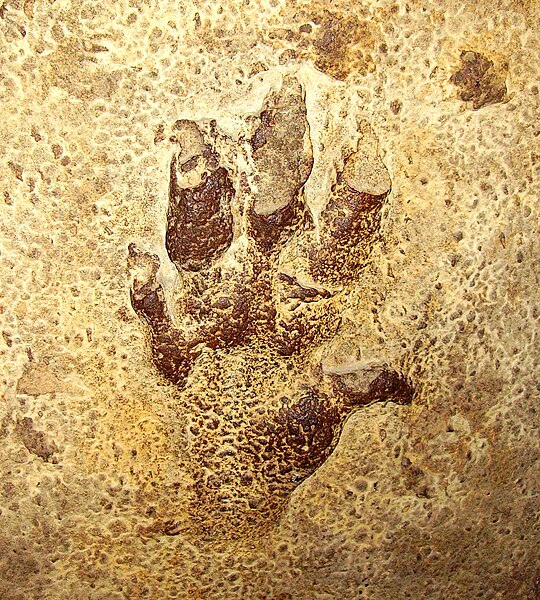
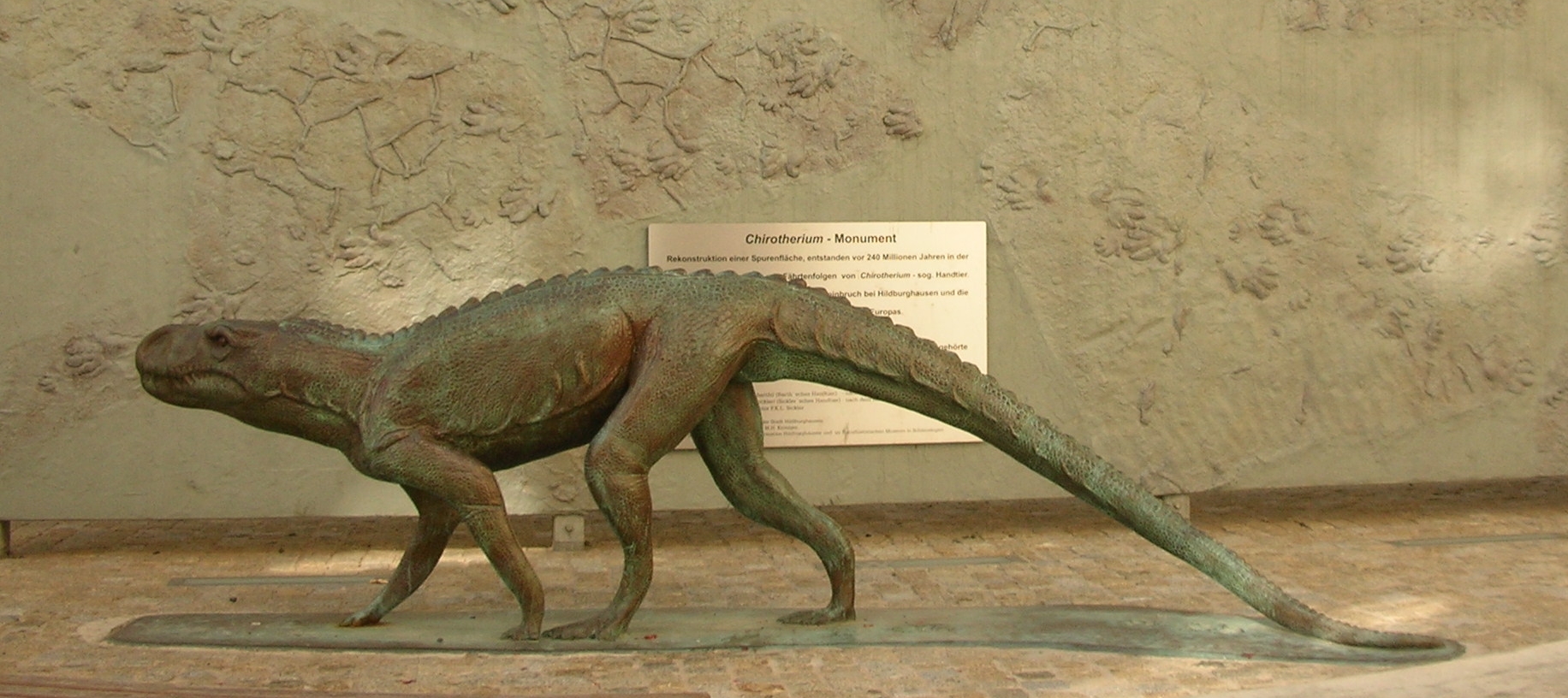
For instance, the german Wikipedia article on Chirotherium: Fossilised footprint (ichnite) of the ichnogenus Chirotherium, an archosaur of the Lower Triassic, first found 1833 in Hildburghausen (Thuringia, Germany).

This is just wrong. An archosaur cannot be an ichnogenus.

Unfortunately, Chirotherium literally means something like "hand beast" or "hand animal". However, the term Chirotherium is scientifically used for a certain type of trackway(s), which is found in Sediments with a Triassic age, ranging from Olenikian to Anisian (KLEIN & HAUBOLD, 2007). In fact, Chirotherium is the first scientifically described trackway (KAUPP, 1835) and, by the form of the pes imprints (rear leg) resembling human hands, it animated the early palaeontologists imagination for the mysterious ancient beast that once left its trackway on the wet sand of the vast Triassic plain. In a way the "hand animal" is a chimera of those early days of palaeontological research. From a modern point of (ichno)taxonomic view, the scientific name Chirotherium, however, is attributed to the trace fossil only, although the trace maker most likely was an archosaur of some sort. Yes, you are right, this is scientific quibble but still; it is not correct.
Yours Ichnogeek!


Chirotherium (pes imprint) from the Triassic of Germany.


The "Chirotherium Monument" with a reconstructed "hand beast" (Hildburghausen, Germany)


References:

Kaup, J.J., 1835: Über Thierfährten bei Hildburghausen. Neues Jahrbuch für Mineralogie, Geognosie, Geologie und Petrefaktenkunde. v. 1835, pp. 227-228.

Klein, H., Haubold, H., 2007: Archosaur footprints - potential for biochronolgy of Triassic contintal sequences. In Lucas, S.G., Spielmann, J.A., (eds): The Global Triassic. New Mexico Museum of Natural History and Science Bulletin 41.

Monday, November 10, 2008

Traces First #1: The Cambrian Explosion (CE)

Intro
Phew! This is truly the flagship among evolutionary progresses and one single post surely cannot embrace a topic that provides enough material to fill up book shelfs. In the course of writing this post it became more and more apparent that it is by far too simplistic just to tell that the presence of trace fossils proves that complex bilateral animals inhabited the sea floor long before they are found in decent body fossil faunas. Although this statement would be the very essence in order to maintain the idea of "traces first", the comparison of these two archives and stating that one predates the other is like comparing the incomparable. I will, anyhow, try to emphasize the role of the ichnology in this event later but first I need to take a deep breath and one step back to provide a minimum of framework.

The first and most obvious message: The "Cambrian Explosion" is a term describing the sudden appearance of numerous "modern" phyla in the fossil record. Nothing more and nothing less. This statement is, in a way, the lowest common denominator of the CE-research, because it just outlines the plain observation. Some people confuse the sudden appearance with absolute evolutionary progress. This might be true but actually this is just one way to interpret it. Although much research has been devoted, it still remains enigmatic in several concerns. But it has been proven that the appearance of complex organisms in the fossil record is one of the last chain links in a cascade of modifications in the earth system. Steps of such an impact are not "sudden" nor do they result from a single causative event. The Cambrian radiation (I like this term better) has a (even on the geological time scale) long and complex prologue. So when did it really start?

Fig. 1: What has Christmas to do with the Cambrian Explosion?

Deck the hall with boughs of holly, Fa la la la la la, la la la la.
When does Christmas start? Some people may say at first Christmas holiday when the children get up early to receive their gifts. Other (german) people may say: No, it's on Christmas eve already. You see, it is a local phenomena. However, this is not the whole story. You have to go and get a tree, bake cookies, buy and prepare all the food, invite your relatives, tell Santa what to get for your kids, set up the decoration, make everything shiny etc. pp. In Germany, we have all this tradition like the "Weihnachtsmarkt" (Christmas market?), Nikolaus and so on. This stuff probably all belongs to Christmas as same as Santa Claus, presents and the tree at Christmas eve itself, doesn't it? Yes, for sure, but the true point of no return is when your children and all other relatives unwrapped their presents and gifts and everyone is happy with his/her new toy, jewellery, fragrance, shirts, socks, ties etc. The living room is a mess, everyone is drinking wine, the turkey is torn into pieces, your cat is going crazy and over the next days, you will have to go and visit all the other people you missed for the whole year probably. Although these are holidays, everyone is very busy. But as I noted above, there is many stuff going on in the "advent" of this event already. It requires much preparation to make all this happen and if one parameter is missing, it cannot really be Christmas then for some people.

My opinion: If we look at the beautiful fossil lagerstätten like Chengjiang and Burgess Shale, we see the holidays - the very essence of the event, when everyone is busy, has new toys to experiment with and so on. In some concerns this analogue might not be very appropriate but I think it is very instructive and fairly outlines the complexity. From all what we know (and I read), one cannot really say: "here it all started". It was a process.
Fig. 2: Treptichnus cf. pedum from the lower Middle Cambrian of Jordan. This is not a very typical specimen. We found it during the field session in Jordan. Photo courtesy of G. Mángano.

Trace fossils and their role in the "Cambrian Explosion"
So now back to the actual business. What is the role of ichnology here? As I noted above, the most simple message is that some trace fossils are so complex that their creation requires sophisticated nervous systems and locomotory mechanisms as well as some sort of motivation (= behaviour). Accordingly, trace fossils demonstrate that there were animals, which did match all this characteristics, already before some of them passed into the body fossil record. Therefore, the first really complex trace fossil Treptichnus pedum (fig. 2; for taxonomists: some people prefer Trichophycus pedum, originally described as Phycodes pedum, Seilacher 1955) was chosen to define the base of the Cambrian. T. pedum is an array of alternating banana-shaped burrows that have been created within the sediment. To describe it properly, all three spatial dimensions are needed. Thus, it is a true burrow created by a bilateral-symmetrical animal. In other words, the trace maker had a left and a right side, it had a sense for "up" and "down" and it probably possessed an aperture for all incomings and one for the rest. Older trace fossil assemblages from the Ediacaran are characterised by the presence of horizontal traces only. Typical strategies employed by Ediacaran biota are surface scratchings, horizontal (under-)mat mining, rather unspecialised superficial grazings and something like that. Around the Precambrian-Cambrian-transition, the discovery of the third dimension by benthic organisms had tremendous impact on the environment and the whole face of the earth.

Fig. 3. Cartoon illustrating the 'Agronomic Revolution'.
From Fedonkin et al. 2007. Drawing by Peter Trusler.
I think there is an error at the lower right. It should be "phanerozoic mixgrounds".

What has been very instructively termed by Seilacher (1997) as the "Agronomic Revolution" or "Trophic Escalation", illustrates the fundamental changes across the the pC-C-transition (see fig. 3). First of all, there is a new strategy as demonstrated by deep vertical burrows (Skolithos, Monocriterion, Arenicolites, Teichichnus to name a few): Infaunalisation. Animals appreciated to colonise the sediment column, which is in fact really advantageous because it provides protection from abiotic and biotic stress factors. Furthermore they were able to explore new food sources. (1) Infaunal detritus feeding: Think of the wasted resources in the Ediacaran. Plenty of organic matter that just has been buried beneath sticky algal mats. (2) Suspension feeding: No matter how strong bottom currents are, just evert your feeding apparatus and current will do the rest without disturbing you in your nice burrow. (3) Passive predation: Wait in your hole for a prey that strolls along your burrow. All in all a very progressive strategy. This biotic invention didn't change only the ecological conditions significantly. It affected whole chemical fluxes in the entire ocean. All the soluble components like phosphate, calcium, silica, magnesium re-entered the marine chemical cycle by deep and thorough bioturbation at the expense of mat-sealed sediment-water interfaces. The composition of sea water presumably changed completely. This, in turn, most likely made the subsequent biomineralisation event possible altogether. This fundamental modification was in a way the advent of the big party that is recorded by the terminal Lower Cambrian fossil lagerstätten.

Further complication? Here we go: Jensen (2003) subsumed that rise of trace fossil complexity is not just documented from the lowermost Cambrian. He stated, and convincingly demonstrated that the "Neoproterozoic trace fossils represent the initiation of a rapid but gradual build-up of infaunal activity, which increased markedly in the Cambrian". Furthermore he concludes that the presence of some distinct trace fossil (e.g. Spiroraphe) together with Ediacaran forms suggests that the evolution of bilateral animals is already under way. So when did the so called "Cambrian Explosion" start? You know what? I really do n't know.

Some key resources for this topic are: Seilacher (1956), Seilacher (1974), Crimes (1992), Droser et al. (2002) as already noted Jensen (2003), Seilacher et al. (2005). This story is by far not completely told yet and, in fact, the evaluation of trace fossils in connection with the CE is still a hot frontier in geo/biosciences.


References:

Crimes, T.P., 1992: Changes in the trace fossil biota across the Proterozoic-Phanerozoic boundary. J. geol. Soc. London., vol. 149, pp. 637–646

Droser, M.L., Jensen, S., Gehling, J.G., 2002: Trace fossils and substrates of the terminal Proterozoic–Cambrian transition: Implications for the record of early bilaterians and sediment mixing. PNAS, vol 99. no 20, pp. 12572-12576.

Fedonkin, M.A., Gehling, J.G., Grey, K., Narbonne, G.M., Vickers-Rich, P., 2007: The rise of animals. Evolution and Diversivication of the Kindgom Animalia. Johns Hopkins University Press, Baltimore.

Jensen, S., 2003: The Proterozoic and Earliest Cambrian Trace Fossil Record; Patterns, Problems and Perspectives. Integr. Comp. Biol., vol. 43, pp. 219–228.

Seilacher, A., 1955. 4. Spuren und Fazies im Unterkambrium. In: Schindewolf, O.H., Seilacher, A. (Eds.), Beitrage zur Kenntnis des Kambriums in der Salt Range (Pakistan), Akademie der Wissenschaften und der Literatur zu Mainz, Mathematisch-naturwissenschaftliche Klasse, Abhandlungen, vol. 10, pp. 373 – 399.

Seilacher, A., 1956. Der Beginn des Kambriums als biologische Wende. Neues Jahrbuch fur Geologie und Palaontologie, Abhandlungen 103, pp. 155–180.

Seilacher, A., 1997: Fossil Art. Royal Tyrell Museum of Palaeontology, Drumheller, Alberta, 64 p.

Seilacher, A., Buatois, L.A., Mángano, M.G., 2005: Trace fossils in the Ediacaran–Cambrian transition: Behavioral diversification, ecological turnover and environmental shift. Palaeogeography, Palaeoclimatology, Palaeoecology, vol. 227, pp. 323–356.