Sunday, May 29, 2011

RE: Back to the field...

Almost a year blogging hiatus. I just don't find the time to write sophisticated blog posts on things that are interesting enough. The last year has been pretty busy and there are several manuscripts under review, in preparation or whatever. As soon as some stuff is finally published, I will share some potentially intersting results here. For the time being, take a look at some photographs that I took on the field season last year. In August 2010, I spent four weeks in the western U.S. to get more data on Early Triassic ecosystems from western Pangaea. It's, of course, not purely geologic. Fieldwork is always an experience. Enjoy the shots!


The camp in the Confusion Range. The bright spots are ant nests.


Sunset at the Utah/Nevada-border.


A Great Basin Collared Lizard (Crotaphytus insularis)
seen near Notch Peak, House Range.


Notch Peak, Sawtooth Mountain, House Range, Utah.


A pissed-off Western Black Widow
(Latrodectus hesperus) in my bowl.


The Meekoceras-Inn fighting with the wind.


A rotten Pick-Up-Truck in middle of Tule Valley.
Cambrian rocks of the House Range in the background


Death Canyon, House Range Utah.


Death Canyon, House Range Utah.


Fossil hunting in the Wheeler Shale, House Range, Utah.


A nice evening in the House Range.


Ruins near Santa Clara, Utah.


Shales of the Virgin Formation (some people consider it as a Member).


In the desert west of St. George having a view on
outcrops of the Moenkopi and the Chinle Group.


Me, finding some cool traces.


A dead Desert Horned Lizard (Phrynosoma platyrhinos).


These are the guys I am looking for. I prepare the plates
for later publications directly in the field, haha.


Double rainbow.


Bivalve resting traces Lockeia, Dinwoody Formation, Montana.


Although fully overgrown, these are textbook-like triangular fault
facets and an alluvial fan in between. This seems to be a very
prominent example. It pops out of the internet here and there.
Tendoy Range, near Lima, Montana.


Eumorphotis (left) and Claraia (right), Dinwoody Formation.
Probably the most common bivalves of the Early Triassic.


Hidden Pasture. What a place! Tendoy Range, Montana.
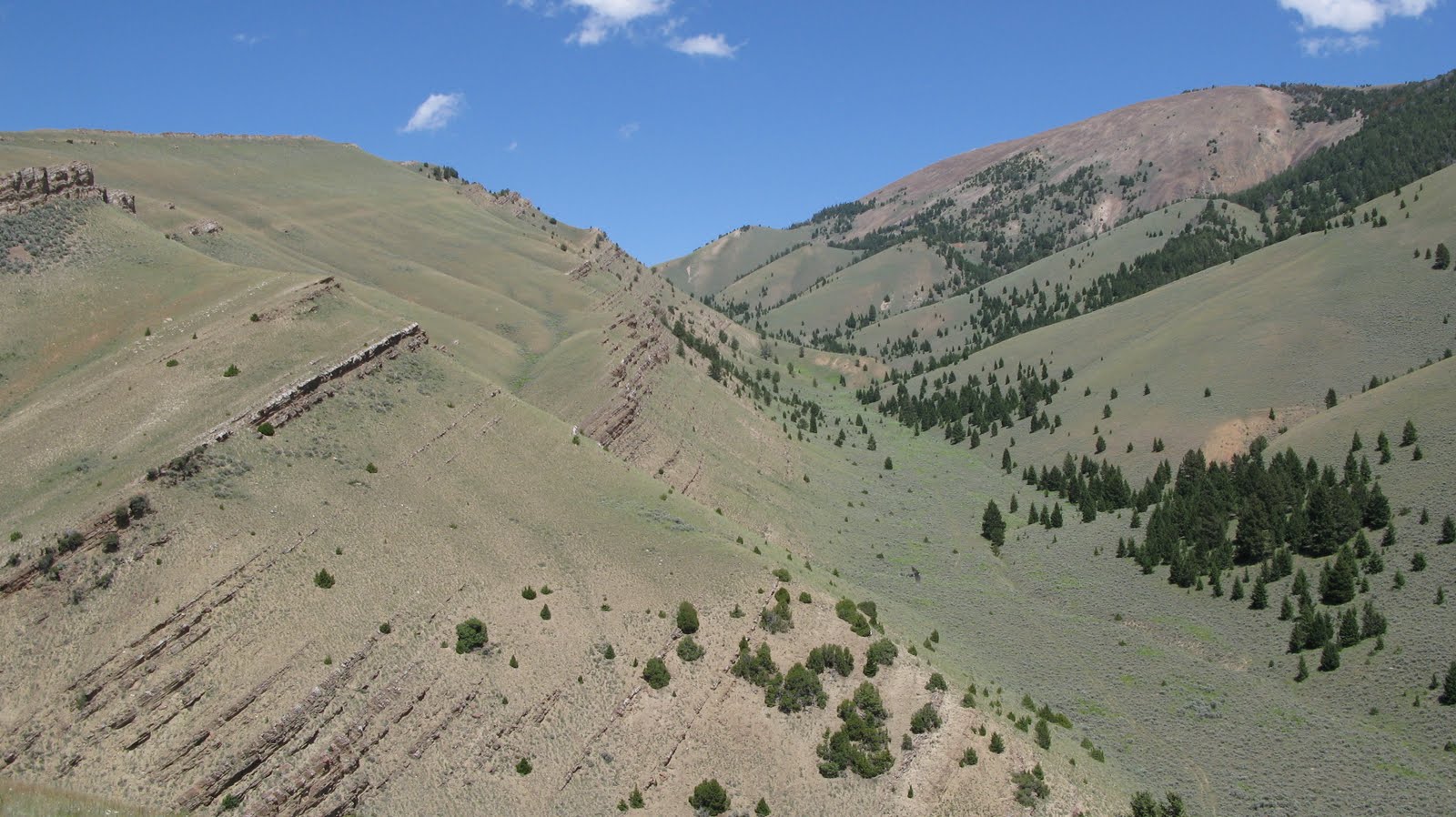

The Dinwoody Formation at Hidden Pasture.


Somewhere in the southern Tendoy Range, Montana.


My car.


Cattle eating gras near Lima, Montana.


Reminded me on " Little House on the Prairie", Ovid, Idaho.

Sunday, July 25, 2010

Back to the field...

Hey, I almost abandoned nologic in most recent times. There are several reasons for this: First of all, in my spare time I mostly change diapers and try to keep my little heir cheerful. This is much fun and I really enjoy being a part of my own family. Next thing is that I devote any bit of time in my office to proceed with my PhD research project. There were some "distractions" recently, so I lost some time doing this and that. I participated in the IPC3 Meeting were I had permission to give a talk. This was really cool and now I know that I am not completely off the map with my research.

I will return to the field tomorrow. There is much to discover in the Western United States (mainly Utah, Idaho) in the Early Triassic. Concerning the weather, it's probably the worst time in the year to perform fieldwork but there is no other opportunity for me (baby). Anyway, I hope for good finds and new insights.

Beside other places I may go to this place:
This photo is supposed to show Hidden Pasture Canyon in southern Montana. The brown rocks on the left could be Lower Triassic. We'll see.

r

Sunday, May 16, 2010

Accretionary Wedge #25: Geo-Image

The current edition of the "Accretionary Wedge" is hosted by Highly Allochthonous. The motif this month is to gather geology-related images. Outcrops, sections, satellite images, minerals, fossils, seismic images, diagramms etc.

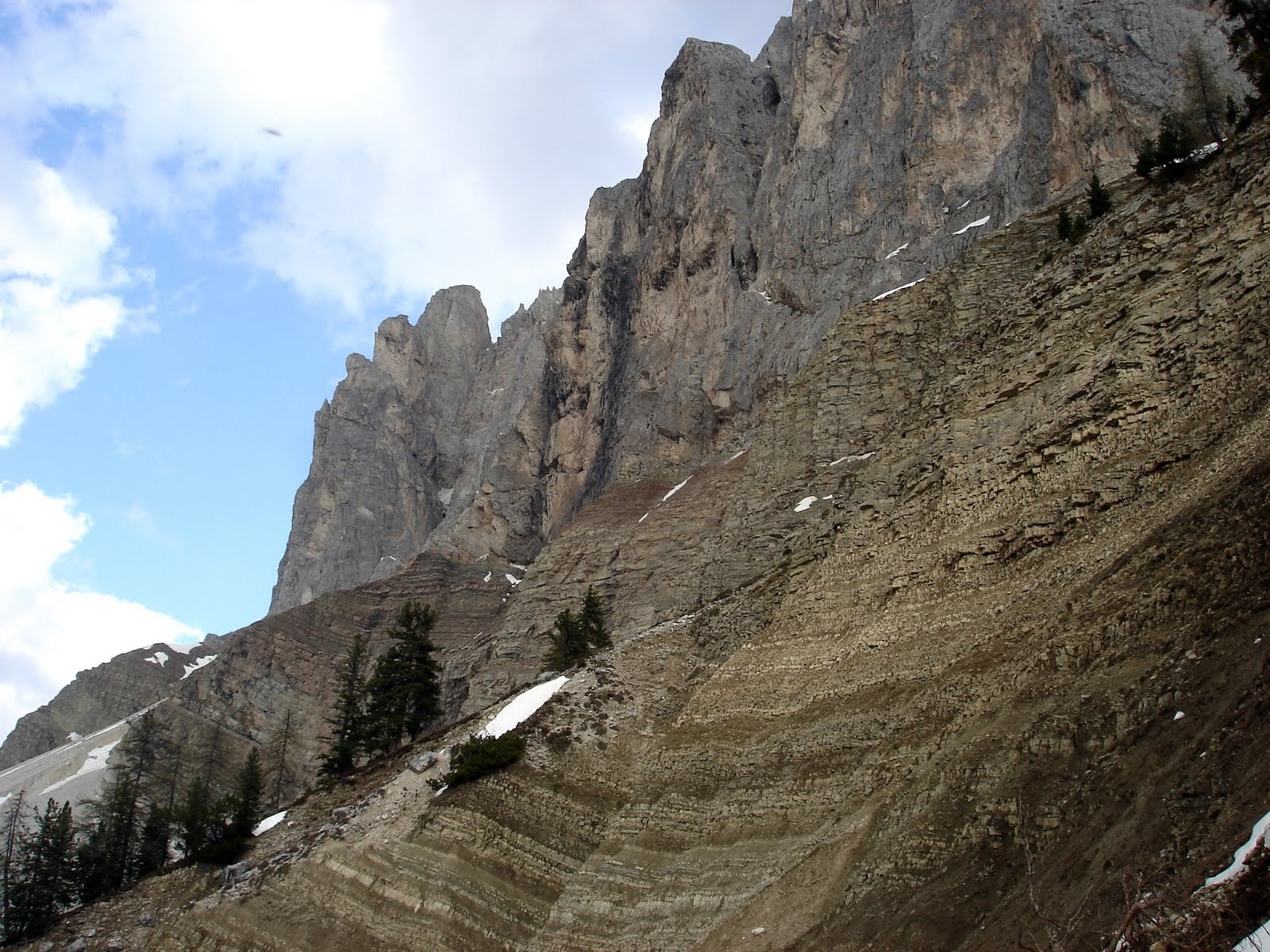
Here is mine: The Permian-Triassic transition epxosed at the Northface of the "Aferer Geisler" (Dolomites, Northern Italy).


The Bellerophon Formation (the brown/yellow succession in the lower part) represents late Permian (Changhsingian) shallow marine to marginal marine environments that yield insight into the pre-extinction world. The end-Permian mass extinction is suggested to have wiped out about 95% of all marine species, and thus is considered as the most severe biotic crisis that metazoan life encountered on our planet. The Werfen Formation (the grey to reddish slope in the middle part of the picture) extends from the latest Permian (latest Changhsingian) to the lower Triassic (Induan/Olenkian) and is one of the best studied succession of the end-Permian mass extinction and its aftermath. In this picture, the extinction level is exposed approximately where the trees end. The steep cliffs forming the top of this range are composed of reef carbonates for which the Dolomites are so noted.

The Dolomite region has been selected as a Unesco World Heritage site. Besides the breath-taking beauty of this landscape, the significance of this region for earth sciences has also been taken into account.

Saturday, May 15, 2010

50 Best blogs for Zoology students

Quite a while ago, it has been brought to me that my blog made it on a list featuring the best blogs for students of zoology. Please follow the link below. I am sure you'll find other blogs that are worth exploring....

50 Best blogs for Zoology students

I am not a very busy blogger, anyway, but I have to announce that my activities here are quite limited at the moment. There is a reason for that: It's male, 8 days old and is keeping me very busy besides doing my PhD. Haha. Nevertheless, there are a couple of posts in preparation that I will spill out as soon as I find some time to shape them a little bit.

best, r

Tuesday, April 6, 2010

Just in case you didn't know: Free digital Geological Maps (USGS)

May be this is just old news for you but possibly it is useful for someone out there. After browsing for basic geological maps of the United States, I discovered a page that solved all of my problems. Here at a page provided by the USGS, you can download geological maps of all states as shapefiles or kml-layer for Google Earth. It is very easy way to find localities for the next fieldtrip for instance.

The north-western area of the Utah Geology layer displayed in Google Earth


Monday, March 29, 2010

Chirotherium World Tour

A team of scientists from the TU Freiberg recently unearthed well-preserved tetrapod footprints from the Triassic of the High Atlas (Morocco). Surprisingly, this ichnofauna is dominated by the ichnogenus Chirotherium, wich is suggested to present an exclusive element of North-Pangean or Laurasian localities that are nowadays associated to Europe, China and North America. Although the scientists are aware that similar trackways were reported from western Gondwana (Argentina; Peabody, 1955), it was stated by several local newspapers that the imprints represent the first occurrences of such traces from Gondwana.

Fig. 1: Pes (the big one) and manus imprint of the ichnogenus
Chirotherium
from the Triassic of Morocco (courtesy of Jan Fischer).


Extensive field work yielded several well-preserved imprints and trackways that can be assigned to the ichnospecies Chirotherium barthii (fig. 1), which is described from (watch out, confusing terms) upper Lower Triassic (Olenekian) to lower Middle Triassic (Anisian) rocks like the Moenkopi Formation of the western U.S. or the Buntsandstein of Central Europe (Klein & Haubold, 2007; and references therein).

As noted above, at least the ichnogenus seems to occur in Argentina as well but the new data from Morocco now strongly support the hypothesis of Peabody (1955) that Chirotherium is a track with a global distribution and its archosaurian producer inhabited the northern and southern hemisphere (see a reconstruction of the palaeoenvironment in fig. 2).

All specimens are currently under investigation by Hendrik Klein, Sebastian Voigt and Jörg Schneider of the TU Freiberg and I expect some interesting papers to be published in near future. For instance, the age of these findings will play an important role in unravelling the evolutionary history of archosaurs.

Fig. 2: A reconstruction of the palaeoenvironment based on the
geological context and sedimentary analysis of the track bearing interval.
Drawn by F. Spindler (taken from Sächsische Zeitung, march 20/21, 2010).


References

Peabody, F.E., 1955: Occurrence of Chirotherium in South America: Geological Society of America Bulletin, v. 66, p. 239-240.

Klein, H., Haubold, H., 2007: Archosaur footprints - potential for biochronolgy of Triassic contintal sequences. In Lucas, S.G., Spielmann, J.A., (eds): The Global Triassic. New Mexico Museum of Natural History and Science Bulletin 41.

Friday, February 26, 2010

Nothing new under the sun...III

Hello,

again I am busy and there is simply no time to fudge more or less significant contributions for nologic. I have several papers in preparation and one is ready for submission. I registered for IPC3, which will be held in London this year. The abstract is already submitted and I hope I can give a talk there.

I added a link somwhere above where you can find short summaries and related publications of projects where I am (or have been) involved. I will keep this updated whenever something changes. If you are interested in some of my insignificant contributions such as abstracts and articles (definitely to come) drop me a line and I will see how I can help you.

Friday, January 8, 2010

Traces First #3: The tetrapod terrestrialisation

This post actually just represents one of those reviews that swamp the internet right now. However, it just fits so perfectly my Traces First-label that I simply can't refuse to put this one on nologic.

Recently, Niedźwiedzki and co-workers (2010) discovered vertebrate trackways in the early Middle Devonian of Poland. These traces, which represent imprints of walking tetrapods, demonstrate that backboned animals walked the earth approximately 20 Million Years earlier than has been previoulsy inferred from body fossils like Tiktaalik and Panderichthys for instance. Tiktaalik from the late Devonian of the Canadian arctic is suggested to represent a sarcopterygian fish, which is closely related to early land-based tetrapods like no other (primary) aquatic animal of the fossil record (Daeschler et al. 2006)

The recent finding from Poland is remarkable for two reasons:

(1) The morphology of the imprints suggests that they were produced by real limbs. If a creature would use stump-like fins as seen in Tiktaalik for extra-aquatic locomotion, the trace fossil would appear more like drag way, not a track way (haha). The traces from Poland show discrete imprints with no drag marks or something. The implication of this feature is that free moving limbs must have evolved much earlier.

(2) The traces were found in a completely unexpected environment. The terrestrialisation of vertrebrates has always been suggested to have happend somewhere in swamp-like landscapes or along river channels. The sedimentary rocks of the trace fossil bearing level are interpreted as strata deposited on a tidal flat. This offers two possibilties: Either first vertrebrates emerged from the marine (which to my knowledge has not been considered so far) or they came from somewhere else. Togehter with point (1), the latter opportunity pushes the terrestrialisation even further back in time.

With the contribution of Niedźwiedzki et al. (2010), another macro-evolutionary step is well predated by means of traces fossils.

As neat video from nature is available on youtube:


References:

Niedźwiedzki, G., Szrek, P., Narkiewicz, K., Narkiewicz, M., Ahlberg, P.E., 2010: Tetrapod trackways from the early Middle Devonian period of Poland , nature, v. 463, p. 43-48 , doi:10.1038/nature08623.

Daeschler, E.B., Shubin, N.H., Jenkins, F.A.Jr, 2006: A Devonian tetrapod-like fish and the evolution of the tetrapod body plan, Nature, v. 440, p. 757-763, doi: 10.1038/nature04639.

Monday, December 21, 2009

Off-topic: My top records 2009

Like last year, I would like to ponder on the most exciting records that this year brought to me...


Coalesce - Ox (relapse records)

I always thought they split up some years ago, so I was a little bit surprised as the band announced a new record and a tour this year. I didn’t expected too much because most of such reunion-records are rather lame and bands usually never find their ingenuity of the “early days”. In this case, however, it is not a typical reunion because they just split and re-formed many times. Long story short: Ox (both, Lp and ep) completely blew me away. It’s like taking the best part of every Coalesce release (including their Led Zeppelin cover album) and welding it to a perfect album. They even made it to include clean vocal parts within some songs, which in my view usually appears misplaced in such music. The blunt guitar riffing topped with the acridly barking vocals is typically coalesce but the clean singing and the almost "morriconesque" interludes really make it a special record. I think this is probaly the last Hardcore album that really means something to me.


Baroness – Blue Record (relapse records)

Gaudiest metal record of all time. Baroness once emerged from a rather rough small cove embedded somewhere between Hardcore/Crust Mountain and a more advanced Heavy Metal Volcano not unlike early Mastodon. At least since their last release “red album” they got a little bit more straight forward and fancy. I don’t mean this in a negative way. The “blue record” follows this path consequently. It twinkles and sparkles with every pearly guitar riff passing your auditory meatus. Not to mention the hymnal vocal parts that instantly reminded me of Hot Water Music. Sometimes, I felt a little embarrassed because some songs are so cheesy but at the same time it sounds amiable and refreshing for this kind of music where every band tries to sound as evil and brutal as possible. This is a honest release of a honest band.


Bat for lashes - Two suns (Emi)

I don’t know too much about pop so I can’t present a thorough review like for the records above. This is a very fragile and spooky pop album that was my background music as I walked through summer nights of Zürich.


Tuesday, December 15, 2009

Run crinoid, run!

This one has been posted already here and there on the net and actually, the paper was published 2.5 years ago. However, this report really surprised me and I want to share my amazement.

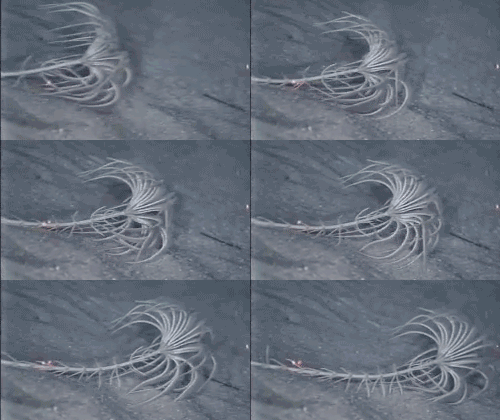
Fig. 1: Gif-movie showing crawling crinoid in quick motion.
Picture from cover of Palaeontologia Electronica Vol 10/1


Baumiller and Messing (2007) report that extant isocrinids are able to move as fast as 10 - 30 mm per second using their "arms" to crawl over the seafloor (fig. 1). Although some groups of crinoids were suggested and proven to perfom some sort of locomotion, the authors provide evidence for an almost "benthic-vagile" lifestyle of a group of organisms that is largely recognized as de facto sessile.

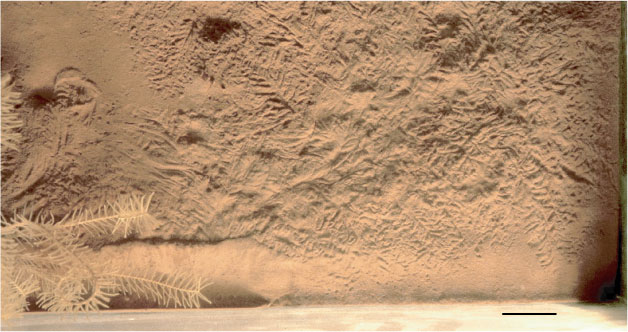
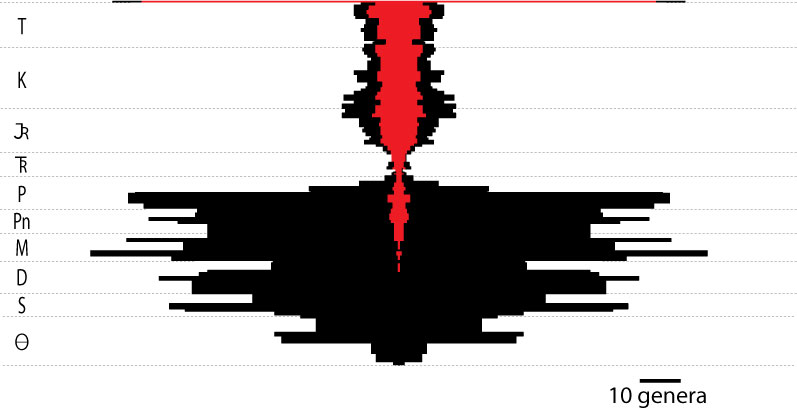
This contribution concerns me for two reasons. First, I am highly interested if there are some trace fossils that were found to represent crinoid locomotion (see fig. 2) and second, the portion of crinoids suggested to apply this kind of locomotion is highest in the Triassic (fig. 3).

Fig. 2: Traces of Davidaster rubiginosa in a fishtank experiment, scale bar: 20 mm (Baumiller and Messing, 2007).


Fig. 3: Generic diversity of crinoids from Ordovician to modern times. Red bars represent the portion of crinoidtaxa that might have been able to perform the observed mode of locomotion (Baumiller and Messing, 2007).


Working in the lower Triassic with a keen interest in ichnology, I will keep this work in my head when returning to the field. Does anybody knows about crinoid trace fossils?


Reference

Baumiller, T.K., and Messing, C.G., 2007: Stalked Crinoid locomotion, and its ecological and evolutionary implications. Palaeontologia Electronica, v. 10/1. http://palaeo-electronica.org/paleo/2007_1/crinoid/index.html

Sunday, November 29, 2009

Hammer Party

Sorry, it is Sunday, I finished my tasks scheduled for today (building up an ikea-something) and my significant other is trapped in a synchrotron somewhere in France. Let me dump the internet with useless information (nothing new, actually).

Probably on every student field trip a picture like this is going to be taken. It was a third years field trip, so you still see tools from DIY markets, which are infact unsuitable for torturing rocks. They easily chip. I once shot a fellow student in the leg while I tried to decompose a cherty limestone. Blood everywhere, I tell you. She sued me and I still have to pay her smart money. So get decent gear for fieldwork. Safety first!

Some details of the story are exaggerated to justify a blog post but basically it's true.

2012

Go and see this movie. Being a geologist, I really enjoyed the part with the Yellowstone eruption (fig. 1). Although 99% of the stuff happening there is far beyond being realistic, the explosion of a caldera appears to be more or less like that (according to what I learned in my volcanics-class). However, the pyroclastic cloud in the movie appears quite comfortable. A real one probably wouldn't release an aircraft that it once caught.

Fig. 1: Zzzzsch-Kraboom

Apart from the CGI earth decomposition, which is well done, I would recommend to movie directors to throw all this emotional crap away and add self-irony and dirt instead. The pretence to create a movie which tries to sell family-compatible ethics although there is terror and destruction everywhere just doesn't work. All of this pathos really destroyed the movie more than the earth has been destroyed in the movie. Haha, but that's okay, they want to earn money. I understand that.

My wish: just show the cool parts and add cool music. I found the following clip on youtube which is pretty close to what I imagine:

Thursday, November 19, 2009

New old Blog

It is online for quite a while so it is not really new: A blog by Kevin Bylund called Ammonoida which is focused on Cephalopds from the U.S. Kevin joined the recent field trip. He is an Ammonite-specialist and there is probaly no one who knows better about the Geology of Utah and adjoining areas.

From the east coast to the west coast...

Recently, I returned from a field trip with American (Jim Jenks and Kevin Bylund) and French (Dr. Arnaud Brayard) Cephalopod researchers. I have been in the south-western U.S. for almost 4 weeks to see the Panthalassian faunas mainly of the Smithian and Spathian (Upper Early Triassic, Olenekian if you want). I've got a lot of things to do right now so I just will post some pictures from the field trip and some ichnologic goodies. Almost everything that is suggested for publication will emerge here (if any) after definite publication. It is not that I am conceited or afraid that someone snitches my ideas but most journals require that the submitted material is not published elsewhere in any form (hence, including blog-posts). In fact, currently I am working on a manuscript on some trace fossils from the Dolomites that I'd love to show you. Anyway back to the U.S. (as always: click to enlarge!):

The ?Thaynes Formation at the Dog Valley locality (Pahvant Range, central Utah).


Our camp with the Thule Valley in the background seen from the Disappointment Hills (Confusion Range, Utah) . The backmost mountains belong to the House Range and are mainly composed of Cambrian sediments.


One of the sections at the Disappointment Hills locality. The succession of interest starts at the right with a calcarenitic bed (the bright bedding plane) blanketing a ?permian paleo-relief. The Triassic here is represented by the Thaynes Formation (Smithian and Spathian) .


Well, the desert can be a lonely place...


...but furry guests show up from time to time.


Thats a locality called Smiths Phalen Ranch near Currie (Nevada). See the post on Ammonoidea.


"Superb" outrcop conditions in NE-Nevada (Winecup Ranch, or something). We weren't even sure if its Lower Triassic at all.


The morning after a 25°C drop in temperature.


The Spathian Virgin Member (stratigraphic nomenclature is debated, some researcher refer to the Vrgin Limestone Formation) near Hurricane. Basically, a shale interbedded with a series of prominent limestone ledges.


The lowermost of such "ledges", here very variable in thickness. It pinches out towards the left. I think it represents an estaury filling incisions in the underlying terrestrial red beds. The base of the Virgin member is highly variable in facies. It must have been a very dissected coastline with shoals, tidal flats, lagoons and estuaries. Honey Moon Trail east of the Hurricane cliffs.


The same little mesa showing the prominent pinch-out towards the left.


The Hurricane Cliffs east of Hurricane (Utah).


So called "wrinkle structures". Little pseudo ripples which are formed by microbial mats. It is considered as an "anachronistic" facies showing up in areas or times when grazing and bioturbation in general is dramatically reduced due to nonexistence of grazers and burrowers (Lower Cambrian) or as a result of a previous massive extinction (Lower Triassic). If you are interested read Pruss et al. 2004 for instance.


An ichnologic goodie: Cruziana in the lower Triassic. Usually, Cruziana is suggested to have been produced by Trilobites. As they went extinct in the course of the end-Permian mass extinction, similar structures can be obviously produced by someone else. A paper dealing with this topic is Zonneveld et al. 2002. The occurence reported in that reference is dated to the Middle Triassic. So my specimen (Spathian Virgin Member) should be the earliest large Cruziana after the end-Permian Mass extinction found so far. Well, the photographed specimen is not the whole story and I hope I can come back to this one when we have better data and a publication.


Me and my little clam truck.


References

Pruss S. B., Fraiser M. L., Bottjer D. J. 2004: The proliferation of Early Triassic wrinkle structures: implications for environmental stress following the end-Permian mass extinction. Geology, 32, 461–464.

Zonneveld J. P., Pemberton S. G., Saunders T. D. A., Pickerill R. K., 2002: Large, Robust Cruziana from the Middle Triassic of Northeastern British Columbia: Ethologic, Biostratigraphic, and Paleobiologic Significance. Palaios, 17, 435-448.